In today’s competitive ecommerce market, product visuals often determine whether a visitor becomes a customer. Online shoppers cannot physically touch or examine products, so images play a critical role in building trust and influencing buying decisions.
This is where product rendering has become increasingly important. Instead of relying solely on traditional product photography, many ecommerce brands now use 3D product rendering to create highly realistic visuals that showcase products from every angle.
When done correctly, product rendering doesn’t just improve how a product looks. It directly affects how many visitors turn into buyers.
What Is Product Rendering?
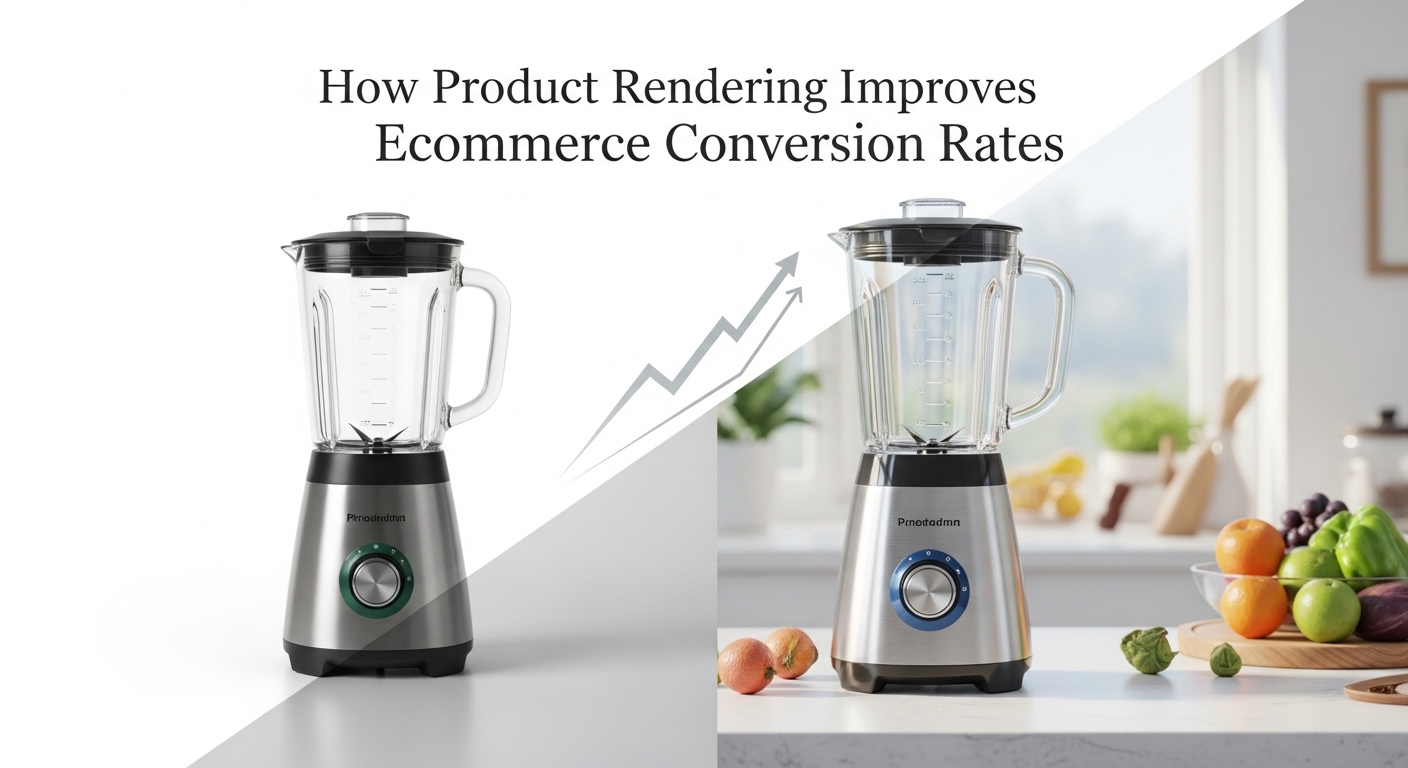
Product rendering is the process of creating photorealistic images of a product using 3D modeling and computer-generated imagery (CGI).
Instead of photographing a physical product, designers build a digital version that can be rendered into high-quality visuals.
Product rendering is commonly used for:
- Ecommerce product listings
- Online marketplaces such as Amazon
- Product launch campaigns
- Advertising and marketing visuals
- Social media content
Because the product exists digitally, brands can generate multiple images, angles, and environments without repeated photo shoots.
Why Product Visuals Matter in Ecommerce
Online shoppers can’t touch, test, or examine a product before buying, so the image does all the convincing. That single fact shapes almost every purchase decision made online.
High-quality product visuals help customers:
- Understand product details clearly, without guesswork
- Visualize how the product actually works or fits together
- Compare features, finishes, and design across options
- Feel confident enough to commit to a purchase without second-guessing
When visuals are sharp and realistic, buyers trust the brand faster and move through the decision process with less hesitation. Poor-quality or inconsistent images do the opposite. They introduce doubt, and doubt is what drives cart abandonment and return requests.
This is where the gap between average product photography and professional 3D product rendering becomes clear. Rendering gives brands a level of visual control that’s difficult to match with photography alone, and that control translates directly into how confidently a shopper clicks “buy.”
Key Ways Product Rendering Improves Conversion Rates
Several advantages make product rendering particularly effective for ecommerce businesses looking to lift conversion numbers.
Consistent High-Quality Visuals
Traditional product photography can vary depending on lighting conditions, camera setup, and production environments, and even small inconsistencies between listing images can make a store feel less professional. 3D product rendering removes that variability entirely. Lighting, angles, and textures can be precisely controlled across an entire catalog, creating a polished look that improves how customers perceive the brand before they even read a product description.
Show Products From Multiple Angles
Online shoppers want to see products from every possible angle before making a purchase decision, and the more angles they get, the less they have to guess. With 3D rendering, brands can easily generate front views, side views, close-up details, and full 360-degree product views without scheduling a new photo shoot for each one. This kind of visual depth is exactly what Shopify recommends for reducing purchase hesitation on product pages. This level of visual detail reduces the uncertainty that often stops a shopper right before checkout.

Faster Product Launches
Traditional photography requires a finished physical product before marketing materials can be created. Product rendering removes that dependency, letting ecommerce brands start marketing, list pre-orders, and test buyer interest before manufacturing is even complete. Getting a clear, realistic product page in front of buyers earlier means more time to capture demand and convert early interest into sales.
Easy Product Variations
Many ecommerce products come in multiple variations such as colors, materials, or finishes. With traditional photography, each variation means another shoot. With 3D rendering, variations can be generated digitally by changing textures or materials on the same base model, keeping every version visually consistent so customers can compare options confidently instead of relying on mismatched photos.
Product Rendering vs Traditional Product Photography
Both rendering and photography are useful, but they serve different needs.
| Feature | Product Rendering | Product Photography |
| Requires Physical Product | No | Yes |
| Visual Flexibility | High | Limited |
| Product Variations | Easy to generate | Requires multiple shoots |
| Cost Scalability | Scalable | Cost increases with shoots |
| Ideal Use | Ecommerce & product launches | Physical retail listings |
For many ecommerce brands, rendering provides greater flexibility and scalability, particularly when the catalog includes multiple variants or the product isn’t manufactured yet.
Want a deeper breakdown of when to choose each approach? Read our full comparison in 3D Product Rendering vs Traditional Photography.
Frequently Asked Questions
What is product rendering in ecommerce?
Product rendering is the creation of photorealistic product images using 3D modeling and CGI instead of traditional photography, giving brands full control over lighting, angle, and presentation.
Is product rendering better than product photography?
For many ecommerce businesses, product rendering offers greater flexibility, especially for products with multiple variations or products that haven’t been manufactured yet. Photography still has its place for authentic, real-world lighting.
Can product rendering improve online sales?
Yes. High-quality product visuals improve customer confidence and help shoppers understand product features clearly, which reduces hesitation and can directly increase conversion rates.
Do ecommerce brands use CGI for product images?
Yes. Many modern ecommerce brands use CGI and 3D rendering to create consistent product visuals for websites, marketplaces, and marketing campaigns at scale.
Product rendering has become an essential tool for modern ecommerce businesses. By creating realistic product visuals without the need for physical photography, brands gain more flexibility, faster marketing timelines, and consistent image quality across every listing.
When visuals are clear, consistent, and realistic, buyers hesitate less and convert more. For ecommerce brands focused on growth, professional product rendering isn’t just a design choice. It’s a direct lever on conversion rate.