Every architecture firm eventually asks the same question: should we build our own visualization team, or hand renders to an outside studio? The answer affects your costs, your deadlines, and how your designs look in front of clients.
This guide compares both options side by side, shows what each one really costs you, and gives you a simple way to decide. We are an outsourced studio, so we have a view. We have still written this to be fair, including the cases where in-house is the better call.
Quick Answer: Which Should You Choose?
Choose in-house if you have steady, high-volume rendering work every month, need instant turnaround on small revisions, and can keep a full team busy all year.
Choose outsourcing if your workload rises and falls, you need specialist skills for certain projects, or you want to avoid the cost of salaries, software, and hardware.
Choose a hybrid model if you want a small internal team for daily design support and an outside studio for large or deadline-heavy projects.
Not sure yet? Outsource one real project and compare the cost, speed, and quality against your internal estimate. The sections below show how.
In-House 3D Visualization: How It Works
What an In-House Team Does
An in-house team is a group of 3D artists employed directly by your firm. They sit close to designers and project managers, so questions get answered in minutes and design changes flow straight into the model.
Where In-House Wins
- Control: you oversee every stage and keep the render true to design intent.
- Quick small revisions: a colour change or camera tweak can be done the same day without a formal brief.
- Brand consistency: every image follows the same house style.
- Data control: project files never leave your network.
Where In-House Gets Hard
- Fixed cost: salaries, software licenses, and high-performance hardware continue whether the studio is busy or quiet.
- Uneven workload: during slow months the team is underused, and during peaks it is stretched.
- Skill range: one small team rarely covers stills, animation, VR, and AR at a high level.
- Keeping up: rendering engines and tools change quickly, and training takes time and budget.
Outsourced 3D Visualization: How It Works
What Outsourcing Looks Like
Outsourcing means working with an external studio or freelancers who produce renders from your drawings, models, and references. You send a brief, review drafts, and receive final images. Many studios work across time zones, which widens the pool of talent you can access.
Where Outsourcing Wins
- Pay per project: costs follow your workload instead of staying fixed.
- Specialist skills: a studio can offer exterior and interior stills, animation, and AR/VR from one team. See our architectural rendering services for an example of the range.
- Scale on demand: a large batch of images can be split across several artists without you hiring anyone.
- No tooling burden: the studio owns the software, hardware, and training.
For more on this side, read our guide to the key benefits of outsourcing 3D architecture modeling.
Common Concerns and How to Handle Them
- Communication: agree on a single point of contact, a clear brief template, and fixed review rounds.
- Time zones: a different time zone can help, since work continues while you are offline, but live discussions need overlap. Set regular review windows.
- Data security: sign an NDA and use secure file transfer before sharing project files.
- Quality control: ask for a portfolio in your project type and start with a small paid or sample project.
What In-House Really Costs (and What to Compare)
The most common mistake is comparing one salary to one invoice. Compare yearly totals instead.
In-house yearly cost includes:
- Salaries and benefits for each artist
- Software licenses and renewals
- Workstations and render hardware, plus upgrades
- Training time for new tools
- Idle time in slower months
- Management time spent briefing and reviewing
Outsourcing yearly cost includes:
- Project fees for every job you send out
- Your own time spent briefing and reviewing
- Revision rounds beyond what the quote covers
Add up both lists using your own numbers. If your yearly in-house total is lower than what you would spend on outside projects, and the team stays busy, in-house makes financial sense. If the team would sit idle for part of the year, outsourcing usually wins on cost. Our full guide to outsourcing architectural visualization walks through the process and the real numbers. Our price list can help you estimate the outsourced side.
In-House vs Outsourced 3D Visualization: Side-by-Side Comparison
Factor | In-house | Outsourced | Better fit |
|---|---|---|---|
Cost structure | Fixed monthly commitment | Pay per project | Outsourced for uneven workloads, in-house for steady volume |
Small revisions | Very fast, same room | Fast with a clear brief, slower without one | In-house |
Large batches and deadlines | Limited by headcount | Work split across more artists | Outsourced |
Style range | Consistent house style | Wider range of approaches | Depends on your need |
Scalability | Needs hiring | Scales up and down | Outsourced |
Confidentiality | Full internal control | NDA and secure transfer needed | In-house |
Brand consistency | Strongest | Needs a style guide and references | In-house |
Software and hardware | You buy and maintain | Provider’s responsibility | Outsourced |
When In-House Is the Right Choice
In-house works best when:
- Rendering is a daily need, not an occasional one
- Your projects are highly confidential
- You need design changes visualized immediately
- A single, strict house style matters more than variety
- You can keep a team fully occupied through the year

When Outsourcing Is the Right Choice
Outsourcing works best when:
- Your workload changes from month to month
- You are a small or mid-sized firm without the budget for a full team
- You need skills you do not have, such as animation, VR, or AR
- You have deadline spikes around competitions, approvals, or client pitches
- You want to test visualization before committing to hires
As CGArchitect notes, virtual outsourcing teams give firms scalability and flexibility without long-term commitments.
Hybrid Model: What to Keep In-House and What to Outsource
Most firms end up with a mix. A simple way to split the work:
Keep in-house:
- Early concept views and massing studies
- Quick internal review images
- Small revisions to existing scenes
Outsource:
- Final marketing-quality exterior and interior renders
- Animations and walkthroughs
- Large batches that land near a deadline
- Specialist work such as AR or VR
To keep the hybrid model smooth, share a style guide, name one contact on each side, and agree on file formats and folder structure before the first project.
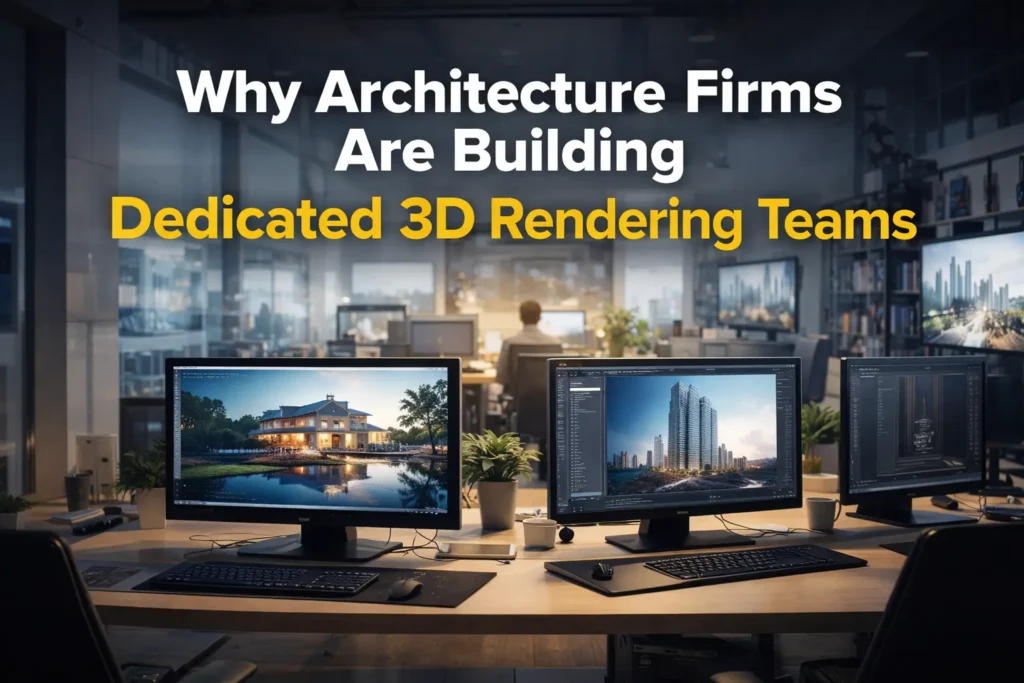
If you are weighing a bigger internal setup, our article on why architecture firms are building dedicated 3D rendering teams covers that route in more depth.
How to Decide in Four Steps
- Map your workload. Note how many visualization projects you handle across a year and how evenly they are spread.
- Total your in-house cost. Use the list above and include idle time.
- Test an outside studio. Request a quote or a free sample on a real project.
- Compare the results. Judge cost, speed, quality, and how much of your own time each option needed.
Where Architectural Visualization Is Heading
Real-time rendering, AR/VR, and AI-assisted workflows are changing how visuals are produced. For in-house teams, that means ongoing training and new tools to buy. For outsourced partners, keeping up is part of the job. Either way, choose the setup that lets you adopt new tools without slowing your projects down.
Conclusion: Making the Right Choice for Your Firm
- Steady, high-volume work and strict confidentiality: build in-house.
- Variable workload, smaller budget, or specialist needs: outsource.
- Mixed needs: go hybrid, with a small internal team for quick work and an outside studio for finals and peaks.
The right choice is the one that fits your workload, not the one that sounds more impressive. Run the four-step check above before you commit.