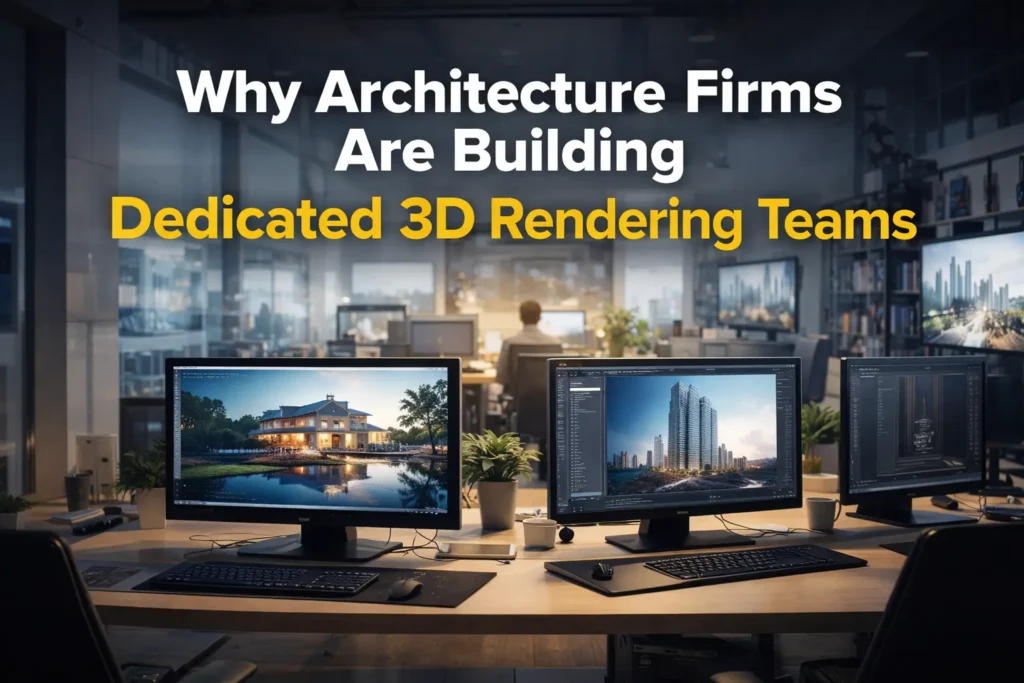

In today’s fast-paced real estate and construction world, visuals speak louder than words. For architects and developers, the decision to outsource architectural visualization has become a game-changer — offering access to photorealistic 3D renderings without the overhead of building an in-house team.
This complete guide explains why professionals choose to outsource architectural visualization in 2026, how the process works, real cost comparisons, common mistakes to avoid, and how to find the right studio for your project.
What is Architectural Visualization Outsourcing?
Architectural visualization outsourcing means hiring an external 3D studio or freelancer to create digital renderings, walkthroughs, and animations of buildings — instead of relying on in-house staff.
Common outsourcing deliverables include:
- Photorealistic exterior and interior 3D renderings
- Floor plan renders and site visualizations
- Virtual reality (VR) walkthroughs
- 360-degree panoramic views
- Architectural animations and flythrough videos
- Product visualization for real estate marketing
This approach gives firms access to cutting-edge technology and skilled artists without heavy infrastructure costs. Learn more about what’s involved in professional architectural rendering services.
Why Architects & Developers Outsource Architectural Visualization
There are several compelling reasons professionals prefer outsourcing in 2026:
- Time efficiency — Specialist studios deliver faster using parallel teams and pre-built asset libraries
- Cost reduction — No software licenses, hardware costs, or full-time salaries
- Access to expertise — Outsourced teams bring niche knowledge in rendering, lighting, and texturing
- Scalability — Handle multiple large projects without stressing internal resources
- Better client satisfaction — High-quality visuals improve client approvals and marketing results
- Focus on design — Free your team to concentrate on creative and strategic work
How Outsourcing Architectural Visualization Works — Step by Step
- Project briefing — Share your CAD files, sketches, PDF plans, or Revit models with the studio. The more detail you provide, the more accurate the result.
- Scope & timeline agreement — Define deliverables, camera angles, materials, and deadlines. A good studio confirms scope within 24 hours.
- 3D modeling — The studio builds or refines the 3D model based on your files.
- Draft renders — Initial previews are sent for your review and feedback before final rendering begins.
- Revisions — Adjustments are made based on your input. Check how many rounds the quote includes before you start; two is the common standard.
- Final delivery — High-resolution images, animations, or VR-ready files delivered in your required format.
At 4dviz Studio, a medium space takes 3–5 business days from brief to final delivery — modeling-only work takes 3 days, and a large project 5–10 days — with direct communication throughout. Get a free quote for your next project →
Cost Comparison: Outsourcing vs. In-House Visualization Team
Outsourcing is almost always more cost-effective than maintaining a full in-house visualization department — especially for firms that don’t need rendering work every day.
| Aspect | Outsourced Studio | In-House Team |
|---|---|---|
| Software costs | Included in service | $3,000+ per license annually |
| Salaries | Pay per project only | $40,000–$80,000 per employee/year |
| Hardware | Not your concern | $5,000–$15,000 for render workstation |
| Flexibility | Scale up or down easily | Limited by team size |
| Quality | Industry specialists | Dependent on training level |
| Turnaround | 3 to 10 business days, by project size | Variable, often longer |
Real Outsourcing Pricing in 2026
Pricing varies by studio, complexity, and number of views. At 4Dviz Studio, our pricing is transparent and competitive:
- 3D modeling only — from $95 for a small interior or exterior space, delivered in 3 days (no final renders)
- Modeling with finished renders — from $295 for a medium space, with custom mood lighting and up to 4 images at 2K
- Large or mixed-complexity projects — from $695, with cinematic multi-scene lighting and up to 6 images at 4K or above
- Full project packages — custom quote based on scope
For a detailed breakdown of 3D modeling and rendering costs, see our guide on how much architectural visualization costs in 2026.
Real Case Study: Outsourcing 3D Visualization for a Residential Development
Client: Mid-size developer launching a 12-townhome project
Challenge: Needed 6 interior and 4 exterior visuals in 10 days
In-house estimate: 3 weeks and over $4,000 in design hours
Outsourced to 4Dviz Studio: Delivered in 7 business days for $2,100
- ✅ Visuals used in sales brochure, website, and print ads
- ✅ 3 townhomes pre-sold before construction began
- ✅ 50% lower visualization cost vs. internal approach
Key Benefits of Outsourcing Architectural Visualization in 2026
1. Significant Cost Savings
Outsourcing eliminates salaries, software licensing, hardware upgrades, and training costs. Most firms reduce visualization costs by 40–70% compared to maintaining an in-house team.
2. Faster Project Delivery
Specialist studios use parallel teams, pre-built asset libraries, and streamlined workflows — delivering in days what might take an in-house team weeks. This is critical for client presentations, competitions, and planning submissions.
3. Access to Specialist Expertise
Outsourced teams consist of trained specialists who understand architectural design logic, spatial accuracy, and how to interpret CAD plans, sections, and elevations. They also bring expertise in professional architectural 3D software that would cost thousands to license independently.
4. Scalable Capacity
Whether you need one render or fifty, outsourced studios scale instantly. Perfect for developers launching multiple projects simultaneously or architects entering multiple competitions.
5. No Long-Term Commitment
No hiring, onboarding, or managing additional staff. You get visualization support only when needed — keeping your core team lean and focused on design.
6. More Time for High-Value Design Work
By outsourcing production-heavy rendering work, architects and designers can focus on concept development, client relationships, and design refinement — where their expertise adds the most value.
The Honest Downsides of Outsourcing — and How to Manage Them
Most guides on this subject only list the benefits. The firms that outsource successfully are the ones that went in knowing the trade-offs. Here are the real ones, and what removes each.
1. You lose the conversation across the desk
An in-house visualizer can be asked a question in passing and change a camera angle before lunch. With an outsourced studio, the same change becomes a written request and a wait. On a project where the design is still moving daily, that lag is real and good intentions do not fix it.
What works: keep fast-iteration, exploratory work in-house and outsource the final production renders, where the brief has stopped moving. Splitting the workflow this way gets you the cost saving without the lag.
2. Time zones can quietly cost you a day per exchange
If your studio is several hours ahead, a question raised late in your afternoon is answered the following morning. On a one-week deadline, two of those exchanges consume a third of the schedule.
What works: agree a daily overlap window and an end-of-day written update before the project starts, in writing. A studio that will not commit to either will cost you days it never quoted for.
3. A weak brief costs more than a higher day rate
This is the most common reason outsourced projects go over budget. Vague references produce a render that is technically correct and completely wrong, and the cost arrives as revision rounds rather than line items.
What works: send reference images for materials, light and mood — not just plans. Approve camera positions before any lighting or texturing time is spent. Composition locked early turns revisions into adjustments instead of restarts.
4. Quality varies far more than price does
Two studios quoting the same figure can deliver work a tier apart, and every portfolio is curated. The cheapest quote is frequently the most expensive outcome once revisions and delays are counted.
What works: pay for one small real project before committing to a package. Judge the studio on your own building, not on their showreel.
5. Confidentiality and file ownership need settling before files move
Unreleased schemes, competition entries and client-owned drawings leave your office the moment you share a file. That is a contractual matter, not a matter of trust.
What works: agree the confidentiality terms and the ownership of final files in writing before the first transfer, not at invoice stage.
6. For some firms, outsourcing is simply the wrong answer
If your practice renders continuously all year, iterates visuals inside the design process itself, and already has the volume to keep an artist fully occupied, an in-house visualizer will cost less per image and respond faster. Outsourcing wins on variable volume, not on constant volume.
What works: count your render-months. If more than roughly eight months of the year carry full-time rendering work, model the in-house option properly before outsourcing.
How 4dviz Studio Handles Outsourced Projects
Everything above is what to look for in any studio. This is how we answer it.
- A 15-artist team, not a single freelancer — six images due on the same day means several artists working in parallel rather than one artist working nights. We have delivered over 500 projects since 2019.
- Separate quality control before anything reaches you — dedicated QC roles sit alongside the production team, and every project is reviewed by a founder rather than passed through account managers.
- Published pricing — our rates are on the 4dviz price list rather than behind a quote form, so you can compare before you enquire.
- Draft previews before final rendering — you review and redirect while changes are still cheap, which is where most revision cost is avoided.
- 3 to 10 business days by project size — 3 days for modeling only, 3–5 for a medium space with finished renders, 5–10 for a large project. Rush delivery is available.
- Whatever files you have — CAD, Revit, SketchUp, PDF plans or hand sketches. You do not need a finished model.
- Clients across the USA, UK, Europe, Canada and Australia, invoiced in USD, GBP, EUR, AUD or CAD by bank transfer, PayPal or Wise.
Start with one project. Request a free sample on your own building, or get a fixed quote.
Trends in Architectural Visualization Outsourcing — 2026
- Real-time rendering with Unreal Engine 5 — Studios now offer interactive real-time walkthroughs clients can explore in VR
- AI-assisted rendering — AI tools accelerate texturing, lighting, and scene generation — reducing delivery times
- AR/VR property showcases — Buyers can walk through unbuilt properties using VR headsets or mobile AR apps
- Cloud-based collaboration — Real-time file sharing and feedback platforms make remote outsourcing seamless
- Sustainable design visualization — Growing demand for renders showcasing eco-friendly materials, green spaces, and energy-efficient features
Top Mistakes to Avoid When Outsourcing 3D Rendering
- Unclear briefing — Vague instructions lead to mismatched expectations and wasted revisions. Share as much detail as possible upfront.
- Choosing based on price alone — The cheapest option often compromises quality. Focus on value — quality renders that convert clients are worth the investment.
- Skipping contracts — Always agree on deliverables, timelines, and revision policy in writing before work begins.
- Not checking portfolios — Always review past work before hiring. Look for projects similar to yours in style and complexity.
- Ignoring revision policy — Get the number of included feedback rounds written down before work starts, along with what a further round costs. Agreeing it informally is how extra charges appear later.
- Not starting with a trial project — For new studios, start with one small project before committing to a full campaign.
How to Choose the Right Architectural Visualization Studio
Finding the right outsourcing partner is crucial. Here’s what to look for:
| Factor | What to Look For |
|---|---|
| Portfolio quality | Photorealistic results across varied project types — residential, commercial, interior, exterior |
| Client reviews | Testimonials from architects and developers, not just general design clients |
| Software stack | Uses professional tools — 3ds Max, V-Ray, Corona, Unreal Engine, Blender |
| Pricing transparency | Clear pricing with no hidden costs — fixed rates or detailed project quotes |
| Communication | Direct contact with your project team, regular updates, fast response times |
| Revision policy | A stated number of included rounds, in writing, and what a further round costs |
| Turnaround time | A delivery date confirmed in writing before starting, sized to the project rather than a blanket promise |
Frequently Asked Questions
Is outsourcing architectural visualization cost-effective?
Yes — significantly so. Outsourcing eliminates overhead costs including software licenses ($3,000+/year), salaries ($40,000–$80,000/year per artist), and hardware. Most firms save 40–70% compared to maintaining an in-house visualization team. At 4dviz, architectural 3D modeling starts at $95, and modeling with finished renders starts at $295.
What is the difference between outsourcing 3D rendering and in-house visualization?
In-house visualization means employing full-time 3D artists with dedicated software, hardware, and ongoing training costs. Outsourcing means paying only for the renders you need, when you need them — with no fixed overhead. Outsourcing is better for firms without a constant, high-volume need for renders. In-house works for large studios with continuous, high-volume rendering requirements.
How do I find an affordable architectural rendering studio?
Look for studios with transparent pricing, a strong portfolio of work similar to yours, and clear revision policies. Avoid choosing on price alone — the cheapest option often costs more in revisions and delays. 4Dviz offers competitive, transparent pricing starting from $95 for modeling and $295 for modeling with finished renders, delivered in 3 to 10 days depending on project size. Contact us for a free quote →
What files do I need to provide to outsource architectural visualization?
Most studios — including 4Dviz — work with CAD files (DWG, DXF), SketchUp models, Revit files, PDF floor plans, hand sketches, and reference photos. You don’t need a polished 3D model — the studio handles modeling from your drawings.
How long does outsourced architectural visualization take?
Delivery times vary by complexity. At 4dviz, modeling-only work takes 3 days, a medium space with finished renders 3–5 business days, and a large project 5–10 business days. Rush delivery is available for urgent projects. Full animation packages take longer — typically 2–3 weeks depending on scope.
Can I outsource just part of my visualization workflow?
Yes. Many architects outsource only the final rendering — handling modeling internally and sending the scene file to a studio for lighting and rendering. Others outsource the full pipeline from CAD files to finished images. Most studios offer flexible arrangements based on where you need support.
What software do outsourced studios use for architectural visualization?
Professional studios use industry-standard tools including 3ds Max, V-Ray, Corona Renderer, Blender, and Unreal Engine 5. At 4Dviz, our primary pipeline uses 3ds Max with V-Ray and Corona for photorealistic output, alongside Blender for specific project types.
Ready to Outsource Your Architectural Visualization?
Outsourcing architectural visualization in 2026 offers architects and developers a smarter, more cost-effective way to deliver stunning project visuals. With global talent, AI-powered tools, and fast turnaround times, outsourcing ensures quality without the overhead.
At 4Dviz Studio, we work with architects and developers across the USA, UK, Australia, and Europe — delivering photorealistic renders in 3–5 business days for a medium space, with two revision rounds included and pricing published up front.
- ✅ Architectural 3D modeling from $95, modeling with finished renders from $295
- ✅ 3 to 10 business day turnaround, by project size
- ✅ Two revision rounds included, unlimited minor tweaks on Premium
- ✅ Works with CAD, SketchUp, Revit, and sketches
- ✅ Direct communication with your project team
Get a free quote for your next project → View our portfolio →
Also read:
4Dviz Architectural Rendering Services
Best 3D Modeling Software for Architecture in 2026
How Much Does Architectural Visualization Cost in 2026?
The Role of Lighting in High-Quality 3D Architectural Visualization
Best Interior Design Rendering Software in 2026