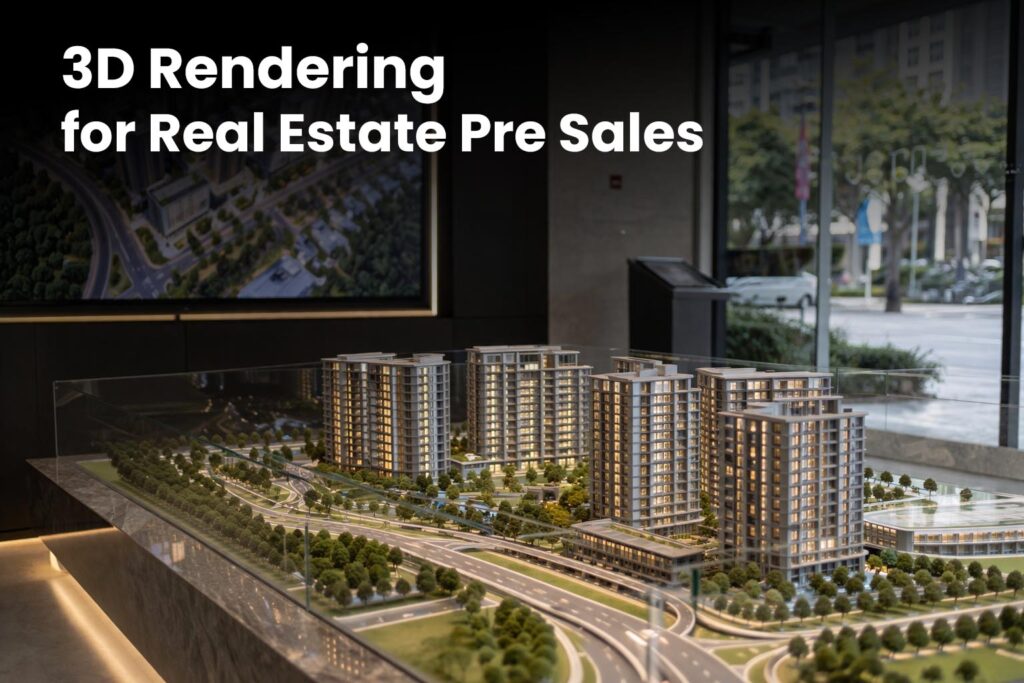

What Makes 3D Architectural Model Cost Go Up or Down
If you’re budgeting for a 3D architectural model, it’s important to understand: not all models are created equal. Pricing depends on multiple factors, including:
- Project complexity (residential, commercial, urban)
- Level of detail (LOD 100 to LOD 500)
- Number of views or renders needed
- Software and rendering engine used
- Turnaround time and revision rounds
At 4dviz Studio, we provide transparent, tailored pricing based on your specific needs—whether you’re pitching to investors, pre-selling properties, or visualizing a future build.
Average 3D Architectural Model Cost in 2026
Here’s a snapshot of average pricing across the industry:
| Project Type | Low-End | Mid-Range | High-End / Custom |
| Single Room Interior | $150–$300 | $400–$750 | $800–$1,200+ |
| Small Residential House | $250–$500 | $600–$1,000 | $1,200–$2,000 |
| Multi-Family or Villas | $800–$1,200 | $1,500–$2,500 | $3,000+ |
| Commercial / Office Space | $1,000 | $1,800–$3,000 | $4,000–$6,000 |
| High-Rise or Urban Masterplans | $2,000 | $3,500–$6,000 | $7,000+ |
Note: These prices typically include basic 3D modeling, 2–3 camera views of clay renderings, and 2 round of revision.
What Influences 3D Architectural Model Cost?
1. Project Complexity
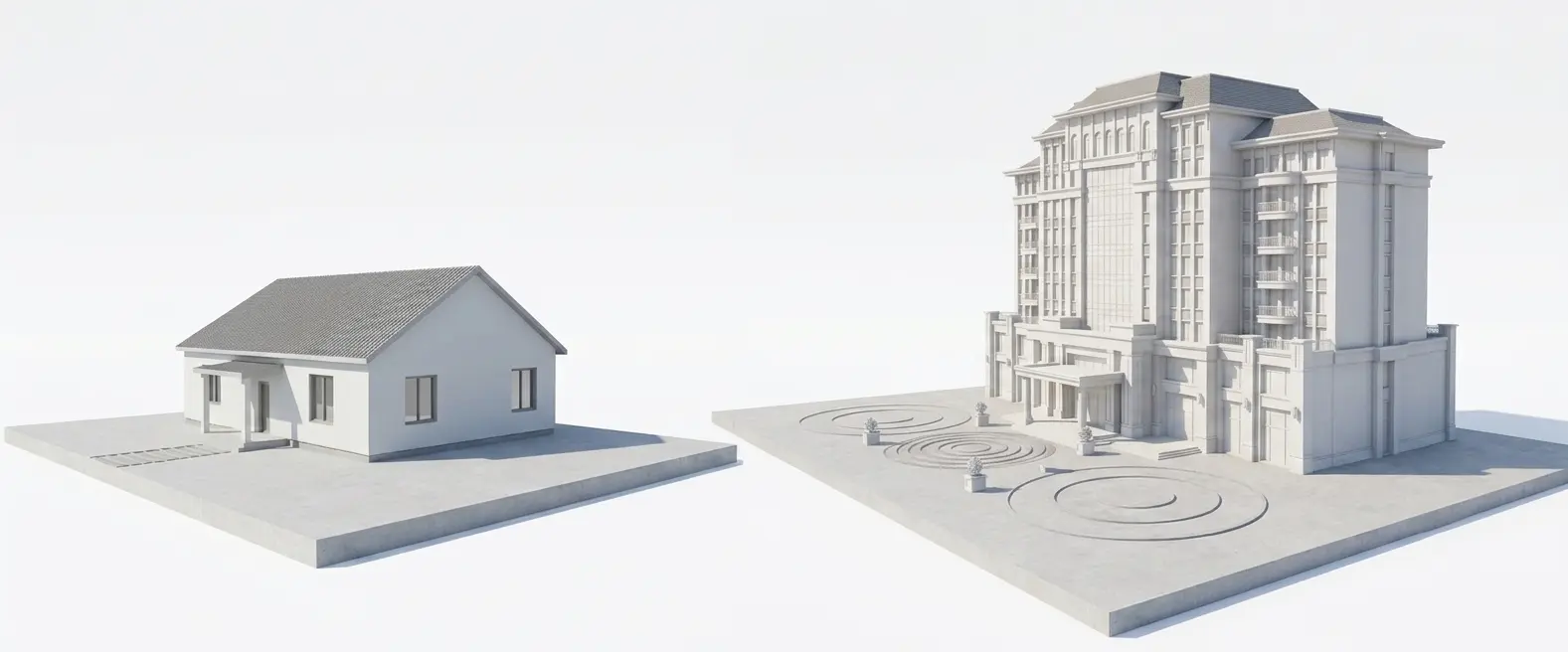
Complexity is the single biggest pricing driver. A studio charges for time, and time scales directly with how many elements need to be modeled, textured, and lit.
| Complexity level | Example project | Typical time to model | Cost impact |
|---|---|---|---|
| Simple | Single room, minimal furniture | 8–15 hours | Base price |
| Moderate | Full residential house, standard landscaping | 20–40 hours | 2–3× base |
| High | Multi-unit building, detailed interiors | 50–100 hours | 4–6× base |
| Very high | High-rise, urban masterplan, complex facades | 100+ hours | Custom quote |
What specifically adds complexity:
- Non-standard geometry (curved walls, irregular rooflines, cantilevered structures)
- Dense landscaping and site context (trees, pavements, neighboring buildings)
- Custom furniture or bespoke fixtures that don’t exist in stock libraries
- Multiple connected interior spaces shown simultaneously
- Tight or unusual camera angles that require extra modeling of otherwise hidden areas
A flat-roofed rectangular house costs significantly less than an equivalent-size home with a complex pitched roof, dormers, and a wraparound deck — even if the square footage is identical.
2. Level of Detail (LOD)
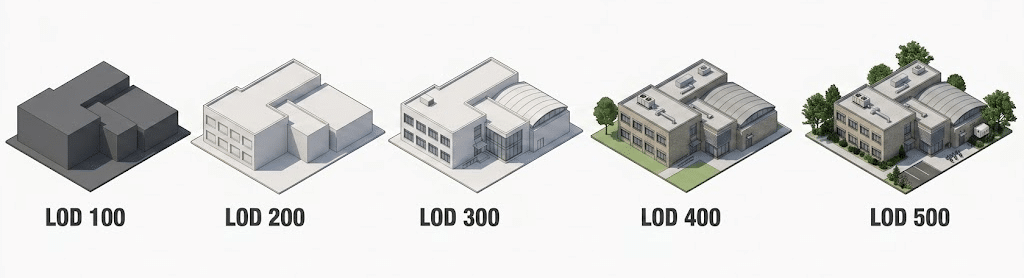
| LOD level | Description | Use case | Price range vs LOD 100 |
|---|---|---|---|
| LOD 100 | Massing and basic volumes | Early concept, zoning | Base |
| LOD 200 | Basic shapes and main components | Feasibility studies | +30–50% |
| LOD 300 | Accurate geometry, material suggestions | Planning approval visuals | +80–120% |
| LOD 400/500 | Fully detailed, photorealistic | Marketing, pre-sales, investor decks | +150–300% |
The jump from LOD 300 to LOD 400 is where cost increases most steeply. At LOD 400, everything visible in the frame needs to be intentional — light switches, door handles, grout lines, fabric weave on cushions. That level of craft takes time.
3. Type of Deliverables
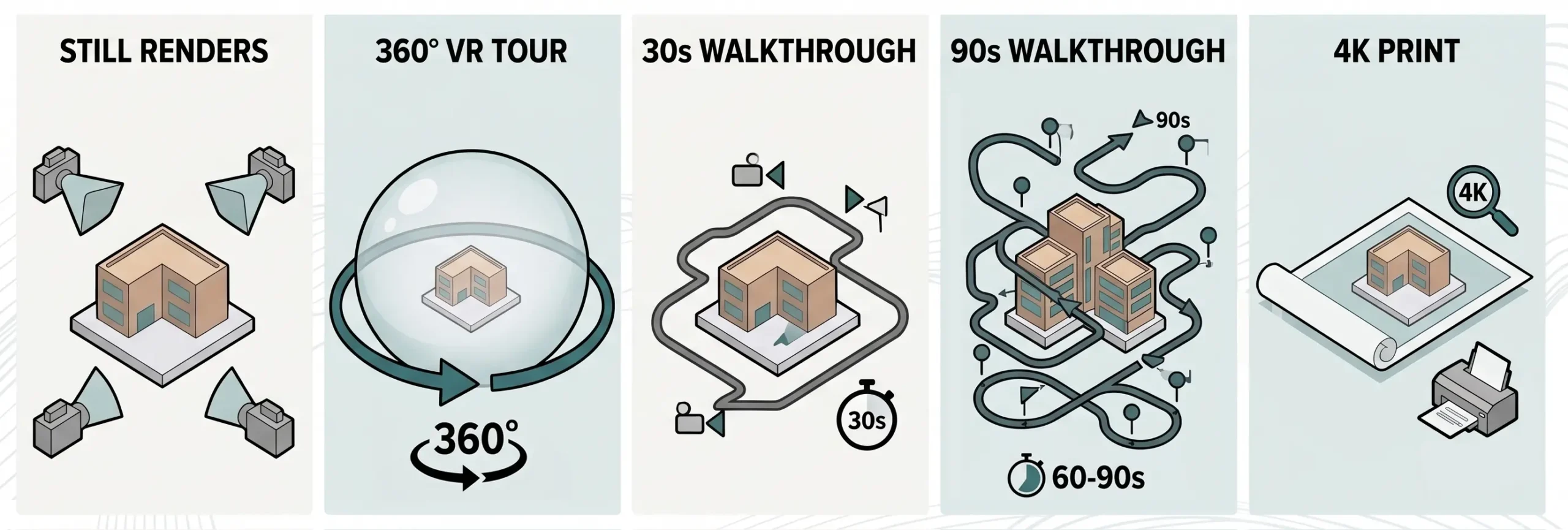
Each additional camera view is not just a button click — it often requires re-lighting, re-staging props, and separate post-processing. Budget accordingly.
| Deliverable | Approx. add-on cost | Notes |
|---|---|---|
| Additional still render (same model) | +$80–$200 per view | Cheaper once model is built |
| 360° panorama / VR tour | +$300–$600 per scene | Requires full 360° environment |
| Walkthrough animation (30 sec) | +$750–$2,000 | Frame count, camera path complexity |
| Walkthrough animation (60–90 sec) | +$1,800–$4,500 | Frame count, camera path complexity |
| Print-ready 4K resolution | +$100–$250 | Larger render times, output files |
The model itself is the expensive part. Once built, additional views from the same model are relatively cheap — so batching your deliverables in one project order saves significantly compared to ordering views separately.
4. Turnaround Time & Revisions
| Turnaround | Typical premium | Notes |
|---|---|---|
| Standard (7–10 business days) | No premium | Normal scheduling |
| Express (3–5 business days) | +20–30% | Studio prioritizes your project |
| Rush (1–2 business days) | +50–100% | Requires overtime or reshuffling pipeline |
Revisions are typically included for up to 2 rounds. A “revision” means adjusting something already modeled — changing a camera angle, swapping a material, tweaking lighting. It does not mean redesigning the layout or adding new rooms. Those are scope changes and are quoted separately.
5. Studio location and overhead
A US-based studio carries higher overhead (salaries, office costs, local taxes) than an equivalent-quality studio in Eastern Europe or South Asia. This isn’t a quality gap — it’s a cost structure gap. A Bangladesh-based studio with senior artists trained in 3ds Max and V-Ray can produce identical output to a London studio at 40–60% of the price. Review portfolios, not postcodes.
Freelancer vs. Professional Studio: Which Should You Choose?
A freelancer works for small, single renders. But three things make them a poor fit for mid to large-scale projects:
- Limited large-project experience — handling complex architecture with consistent quality is a different skill set entirely
- No team to meet tight deadlines — one artist is a bottleneck when you need multiple views or a full project delivered fast
- Consumer hardware — high-poly architectural scenes, dense landscaping, and complex lighting need professional workstations and render farms, not personal computers
| Freelancer | Mid-tier Studio | Premium Studio | |
|---|---|---|---|
| Single exterior render | $50–$200 | $300–$700 | $800–$1,500+ |
| Exterior + 3 views | $150–$400 | $600–$1,200 | $1,500–$3,000 |
| Full project (10+ renders) | $500–$1,500 | $2,000–$5,000 | $6,000–$15,000+ |
| Turnaround | 2–5 days | 5–10 days | 7–14 days |
| Multiple artists on deadline | ✗ | Sometimes | ✓ |
| Professional render hardware | Rarely | ✓ | ✓ |
| Consistent quality across views | Varies | Usually | ✓ |
| Revision rounds | 1–2 | 2–3 | Unlimited |
| NDA / confidentiality | Informal | Yes | Yes |
Freelancers are cost-effective for simple, low-stakes jobs — a quick concept render or a single room. But for marketing campaigns, investor decks, or pre-sales materials, a studio’s project management, quality consistency, and accountability are worth the premium. A failed render 2 days before a launch costs far more than the savings.
How Studio Location Affects What You Pay
Where a studio is based has a dramatic effect on pricing — not quality. Many top-tier studios in South and Southeast Asia, Eastern Europe, and Latin America produce work that matches or exceeds Western counterparts, at 40–70% lower cost.
| Region | Avg. cost per exterior render | Quality tier |
|---|---|---|
| USA / Canada | $800–$2,500 | High |
| Western Europe (UK, Germany) | $700–$2,000 | High |
| Eastern Europe (Poland, Ukraine) | $300–$900 | High |
| South Asia (Bangladesh, India) | $150–$500 | Medium–High |
| Southeast Asia (Vietnam, Philippines) | $200–$600 | Medium–High |
| Latin America (Brazil, Colombia) | $250–$700 | Medium–High |
The key factors that actually determine quality are software proficiency, lighting skill, and art direction — not the studio’s postal code. When evaluating a non-Western studio, review their portfolio carefully, ask about revision policy, and request a paid test render before committing to a large project.
At 4dviz Studio, our pricing falls in the $150–$800 range depending on scope — while our output is benchmarked against international standards.
How to Get an Accurate Quote — and What to Prepare
A vague brief gets a vague quote. The more precise your input, the more accurate and fair the pricing you’ll receive. Here’s exactly what to prepare before contacting a studio:
Step 1 — Gather your files
Provide whatever you have: CAD drawings, floor plans, SketchUp models, hand sketches, or reference photos. Even rough inputs help. If you have nothing yet, describe the project type, approximate dimensions, and number of floors.
Step 2 — Define your deliverables
Be specific: how many views? Interior or exterior or both? Still renders or animations? What resolution do you need (web-quality 1920×1080, or print-ready 4K+)?
Step 3 — Set your LOD expectation
Share 2–3 reference images from other projects that match the visual quality you want. This is the single most useful thing you can do — it removes ambiguity immediately.
Step 4 — Give a real deadline
A 7-day timeline and a 2-day timeline are priced differently. Don’t ask for a quote “as soon as possible” without specifying the actual date you need the files.
Step 5 — Ask the right questions
When you receive a quote, ask: What’s included in the revision rounds? What file formats will I receive? Do you retain rights to use the renders in your portfolio? What happens if I need changes after final delivery?
At 4dviz Studio, we respond to quote requests within 8 hours and provide itemized pricing — no lump sums.
The Business Case: What 3D Renders Actually Return
A 3D architectural render is not an expense line — it’s a sales and approval tool. Here’s the evidence:
According to data from real estate marketing research, listings with professional 3D visuals sell 31% faster than those using only floor plans or descriptions. Pre-construction properties marketed with photorealistic renders typically command 5–15% higher asking prices due to buyer confidence.
For developers, the math is straightforward: a $1,200 render package on a $500,000 residential unit that closes 6 weeks faster saves roughly $3,000–$5,000 in holding and financing costs alone — before accounting for price premium.
For architects and interior designers, client approval rates on designs presented with 3D renders are significantly higher than flat drawings. Fewer revision cycles mean lower project costs and faster billable completion.
Common ROI scenarios:
| Use case | Render investment | Measurable outcome |
|---|---|---|
| Pre-sales marketing | $800–$2,000 | 20–40% more enquiries vs floor-plan-only listings |
| Investor pitch deck | $1,500–$3,500 | Higher funding confidence, faster decision cycle |
| Planning approval | $600–$1,200 | Reduced back-and-forth with planning authorities |
| Client presentation | $400–$900 | Fewer revision rounds, faster sign-off |
The renders pay for themselves. The question is which stage of your project benefits most.
How to Save on 3D Architectural Model Costs
Most clients overspend not because studios overcharge, but because the brief arrives incomplete, changes happen mid-project, and deliverables aren’t planned from the start. Here’s how to avoid that.
1. Send clean files from the start
If your brief comes in as a PDF scan or rough sketch, the studio spends 8–15 hours just interpreting your drawings before any modeling begins. That time is billable. Providing dimensioned CAD or DWG files cuts setup time to 1–3 hours — a saving of $150–$400 on a typical residential project.
If you don’t have CAD files, a simple measured floor plan with clear dimensions is the next best thing.
2. Batch all views in a single project order
The model is built once. Every extra view ordered after the fact means re-opening the project, re-lighting for the new angle, and re-processing — at a higher per-view rate than if ordered upfront.
Ordering 4 views together typically costs 20–30% less than ordering 2 views, then adding 2 more later. Decide your full deliverable list before the project starts, not halfway through.
3. Lock the design before modeling begins
Every structural change after modeling has started — moving a wall, changing the roof form, adding a floor — requires partial or full re-modeling. A single layout change mid-project can add $200–$600 to the final bill.
Share final or near-final drawings. If your design is still evolving, commission an LOD 100 or LOD 200 massing render first ($150–$400), confirm the design direction, then proceed to the detailed LOD 300/400 work.
4. Use reference images instead of describing the style
“Modern and warm” means different things to different people. A studio that models the wrong style and has to restart costs everyone time. Sharing 3–5 reference images of finishes, furniture style, or lighting mood you want takes 2 minutes and can eliminate an entire revision round — saving $80–$200 in revision time and 2–4 days on the timeline.
5. Avoid rush fees unless genuinely necessary
A 3-day turnaround on work that could have been ordered a week earlier adds 20–30% to the total cost with no quality gain. Plan your render requirements as early in the project timeline as possible. For a 10-render marketing package, a rush fee could add $400–$900 for no reason other than late briefing.
6. Ask about bundled packages
Most studios — including 4dviz — offer package pricing for multi-view or multi-scene projects that works out cheaper per render than individual orders. A 5-view exterior package, for example, is typically priced at 3.5–4× the single-view rate rather than 5×. Ask before you order.