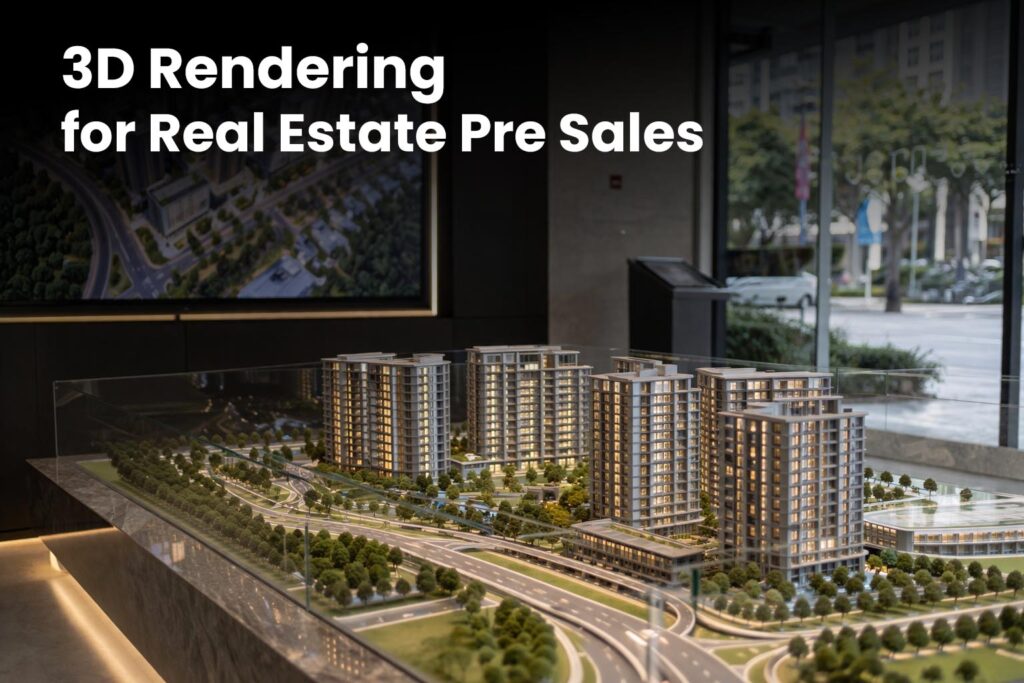

Why Create 3D Models from Sketches?
A sketch is a great way to communicate an idea, but it often leaves room for interpretation. Dimensions, depth, proportions, and materials can be difficult to fully understand from a 2D drawing alone. Converting sketches into 3D models makes concepts easier to visualize, evaluate, and refine before moving into production, construction, or marketing.
For architects, designers, manufacturers, and real estate developers, 3D models provide a clearer representation of the final result. They help identify design issues early, improve communication between stakeholders, and make it easier to present ideas to clients or investors. Whether the starting point is a hand-drawn sketch, floor plan, or concept drawing, a well-built 3D model transforms an idea into something that can be viewed, reviewed, and developed with confidence.
What We Need to Start Modeling from Sketches
Even if you don’t have a DWG or Revit file, we can still build your model—as long as we receive clear references. Here’s what helps:
1. Hand Sketches or Scanned Drawings
- Can be pencil, ink, or digital tablet sketch
- Ideally shows floor plans, elevations, or perspectives
- Add annotations like dimensions or materials (even roughly)
2. Reference Images
- Real-world inspiration for furniture, textures, facades
- Pinterest boards, Instagram saves, or brand lookbooks
3. Rough Dimensions
- Basic width, height, depth
- Room sizes, wall heights, or total square footage
- Optional: ceiling height, window/door size, etc.
4. Notes on Style or Mood
- Modern, classic, industrial, Scandinavian, minimalist?
- Interior lighting type: daylight, moody, ambient?
If you don’t have all of these—that’s okay. The more you provide, the better we can translate your idea into a precise, high-quality 3D model.

Our 5-Step Process to Create 3D Models from Sketches
Turning a sketch into a professional 3D model involves much more than simply tracing lines. Our workflow is designed to ensure accuracy, maintain the original design intent, and deliver models that are ready for visualization, presentation, or production.
1. Brief & Sketch Review
The process begins with a detailed review of your sketches, drawings, reference images, and project notes. At this stage, we identify key dimensions, design features, materials, and any areas that may require clarification. Even rough sketches can provide enough information to start the modeling process when combined with supporting references.
2. Dimension Mapping & Planning
Once the project requirements are clear, we establish the model’s scale and proportions using the dimensions you provide. Accurate measurements are critical for ensuring the final model reflects the intended size and structure. If certain dimensions are missing, we work with you to determine the most practical solution before modeling begins.
3. Detailed 3D Modeling
Using industry-standard software such as 3ds Max, we build the model from the ground up. Depending on the project’s requirements, we can create either low-poly models optimized for real-time applications or highly detailed high-poly models for visualization and rendering. Throughout the modeling process, attention is given to proportions, structural details, and design accuracy to ensure the model stays faithful to the original concept.
4. Quality Check & Model Finalization
Before delivery, the model undergoes a thorough quality review. We carefully inspect topology, proportions, geometry, and overall model integrity to ensure everything is clean and accurate. Any necessary optimizations are completed at this stage, and the model is prepared in the required format for rendering, animation, AR/VR, manufacturing, or other intended uses.
5. Delivery, Feedback & Revisions
After the initial delivery, you have the opportunity to review the model and provide feedback. We believe collaboration is an important part of achieving the best result, so revisions can be made to address adjustments or refinements. Once approved, the final files are delivered in the requested format, ready for the next stage of your project.
This workflow allows us to transform anything from rough sketches to detailed technical drawings into professional 3D models while maintaining accuracy, efficiency, and clear communication throughout the process.
Who Is This For?
Our “sketch-to-model” service is perfect for:
- Architects preparing early-stage concepts
- Real estate developers needing visuals before permits
- Interior designers with hand-drawn floorplans
- Product creators launching new furniture or spatial layouts
- Agencies who want fast, accurate 3D visualizations without needing CAD tools
Why 3D Models from Sketches Work So Well
| Benefit | Why It Matters |
| Saves time | No need for CAD; start from concept immediately |
| Enables faster approvals | Stakeholders understand sketches better with 3D visuals |
| Supports early marketing | Use renders before construction begins |
| Flexible for changes | Edits are fast and easy without redrawing plans |
| Cost-effective | Lower upfront investment vs. full CAD+BIM development |
File Types & Deliverables You’ll Receive
Depending on your needs, we deliver:
- High-resolution renders (JPG, PNG, TIFF)
- 3D geometry (FBX, OBJ, MAX)
- Animated flythroughs or 360° panoramas (on request)
- Scene preview images for review and feedback
Our models are optimized for use in presentations, websites, client pitches, and planning applications.
What Sets 4dviz Studio Apart
- Experience in interpreting creative ideas
- Specialized in non-CAD-based modeling workflows
- Realistic lighting, custom texturing, and post-processing
- Seamless collaboration—even if you’re new to 3D
We’re flexible, fast, and focused on making your ideas look real—before they are.
Ready to Bring Your Sketch to 3d models?
If you have an idea on paper, we can help turn it into a realistic 3D model—ready to your visualization or product rendering project.
Contact 4dviz Studio today to get a free consultation or upload your sketch directly to start the process.