Berlin’s automotive sector sits at an unusual crossroads. The city is home to established manufacturing plants, a dense supplier network, and a fast-growing cluster of mobility and EV startups working a few kilometers apart. That mix means design teams, engineers, and marketing departments are under constant pressure to move faster without inflating budgets. 3D automotive rendering has become one of the more practical answers to that pressure, letting manufacturers visualize a vehicle in full detail long before a single physical part exists.
This isn’t a niche design trick anymore. Rendering now touches engineering reviews, internal approvals, marketing campaigns, and even the configurators customers use to pick trim and color online. For manufacturers weighing whether to bring this into their workflow, it helps to understand exactly where the value comes from and what it looks like in practice.
What 3D Automotive Rendering Actually Involves
3D automotive rendering is the process of building a photorealistic digital model of a vehicle, then lighting, texturing, and placing it in a scene the same way a photographer would set up a physical shoot. Modern rendering software can simulate paint finishes, interior materials, ambient lighting, and even motion with enough accuracy that the result is difficult to distinguish from a photograph.
The difference from a traditional design sketch or a physical clay model is flexibility. Once a vehicle exists as a 3D model, teams can change the color, swap wheels, adjust the environment, or generate an entirely new camera angle in a fraction of the time it would take to reshoot or rebuild a physical version. That flexibility is what makes rendering useful well beyond the design studio.
Why Berlin’s Automotive Sector Is a Strong Fit
Berlin’s automotive footprint includes established manufacturing operations, a large base of component suppliers, and an active scene of EV and mobility startups building new vehicle concepts from scratch. Each of these groups deals with a version of the same problem: getting a design in front of the right people, whether that’s an internal review board, an investor, or a customer, without waiting for a physical unit to be built.
For manufacturers coordinating with suppliers or design partners outside their own building, rendering also solves a communication problem. A CAD file or a technical drawing means different things to different specialists. A rendered image doesn’t require that kind of technical interpretation, which is part of why it tends to speed up sign-off on design decisions rather than slow them down.
Where 3D Rendering Fits Into the Manufacturing Workflow
Rendering rarely lives in one department. In practice, it tends to show up at several points in a vehicle’s development:
Design and engineering validation. Before committing to tooling or a physical prototype, teams can review a rendered model from every angle, test how surfacing and proportions actually look in real lighting conditions, and catch issues that are hard to spot on a flat technical drawing.
Cross-team communication. Design, engineering, and marketing don’t always read the same documents the same way. A rendered model gives everyone a shared reference point, which cuts down on the back-and-forth that happens when departments are working from different assumptions.
Marketing and pre-launch content. Campaigns, trade show materials, and press kits can be built around a vehicle that hasn’t been physically produced yet. This matters most for launches where timing is tight and waiting for a finished unit isn’t realistic.
Interactive and configurator tools. Once a vehicle exists as a detailed 3D asset, it can be adapted into an interactive configurator that lets customers explore colors, trims, and features online, which is increasingly expected in automotive retail.
Key Business Benefits
- Fewer physical prototypes. Design iterations can happen digitally first, reducing how many physical models need to be built and modified.
- Faster internal approvals. A realistic rendered image is easier for non-technical stakeholders to evaluate than a technical drawing, which shortens review cycles.
- Marketing content ready before production. Campaign visuals, catalog images, and trade show assets can be produced in parallel with development instead of after it.
- Clearer supplier and partner coordination. Shared visual references reduce the chance of misalignment between internal teams and outside partners.
- Reusable assets across departments. The same base model can be adapted for engineering reviews, marketing, and customer-facing tools instead of being rebuilt for each use case.
A Practical Example: From Concept Model to Marketing Asset
A typical rendering workflow starts with a base 3D model built from CAD data or design sketches. From there, a studio applies materials, lighting, and environment to match how the vehicle will actually be presented, whether that’s a clean studio shot for a catalog or an outdoor scene for a lifestyle campaign.
Once the base model exists, producing variations is comparatively fast. A different paint color, a new wheel option, or an alternate camera angle doesn’t require rebuilding the scene from scratch. This is the part of the process that tends to save the most time in practice: the heaviest work happens once, and everything after that is a variation on the same asset.
For manufacturers running multiple campaigns or markets, this reuse is often where the real cost savings show up, not in the first render, but in how cheaply the tenth one can be produced.
Choosing the Right 3D Visualization Partner
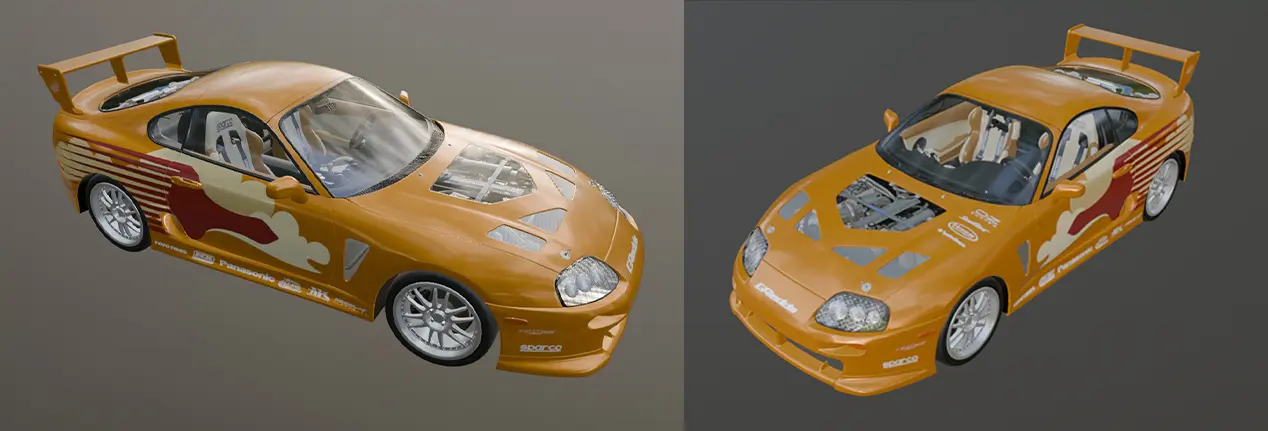
Not every rendering studio is set up to handle automotive work well. Vehicles have reflective surfaces, complex curvature, and material properties like paint depth and glass that are harder to get right than most product categories. When evaluating a 3D visualization partner, it’s worth checking their portfolio specifically for vehicles or similarly demanding surfaces, not just general product work.
It’s also worth asking how a studio handles revisions and turnaround, since automotive projects often go through several rounds of internal feedback before a final asset is approved. A partner who can turn around variations quickly, without starting the scene over each time, will generally be more cost-effective over a full campaign than one who treats each image as a one-off project.
Frequently Asked Questions (FAQs)
What is the main purpose of 3D automotive rendering?
It lets manufacturers create realistic digital vehicle models for design review, marketing, and customer-facing tools before a physical version is built.
Can 3D rendering replace physical prototypes entirely?
No. It reduces how many physical prototypes are needed for design and marketing purposes, but physical testing is still required for safety and regulatory validation.
Is this useful for smaller manufacturers, not just large OEMs?
Yes. Because the process scales with project scope, smaller manufacturers and suppliers can use it for specific needs, like a single marketing campaign, without the overhead of a full in-house pipeline.
Does 3D rendering support sustainability goals?
It can reduce the number of physical prototypes built and cut down on travel and logistics for traditional photoshoots, though the scale of that impact varies by project.
How long does a typical rendering project take?
It depends on the complexity of the vehicle and how many variations are needed, but a base model with a handful of variations is generally quicker to produce than a comparable physical photoshoot.
Do rendered images work for both marketing and technical review?
Yes, though the setup differs. Marketing renders prioritize lighting and environment, while technical review renders prioritize accuracy of proportions and surfacing.
Conclusion
3D automotive rendering has moved from a design-studio tool to something that touches engineering, marketing, and customer experience across the vehicle development process. For Berlin’s manufacturers and suppliers, working in a market where speed and cross-team coordination matter, it offers a practical way to cut prototyping costs and get a vehicle in front of decision-makers and customers earlier.
Looking to add automotive rendering to your workflow?
Get a project quote. See sample automotive work. Talk to our team.