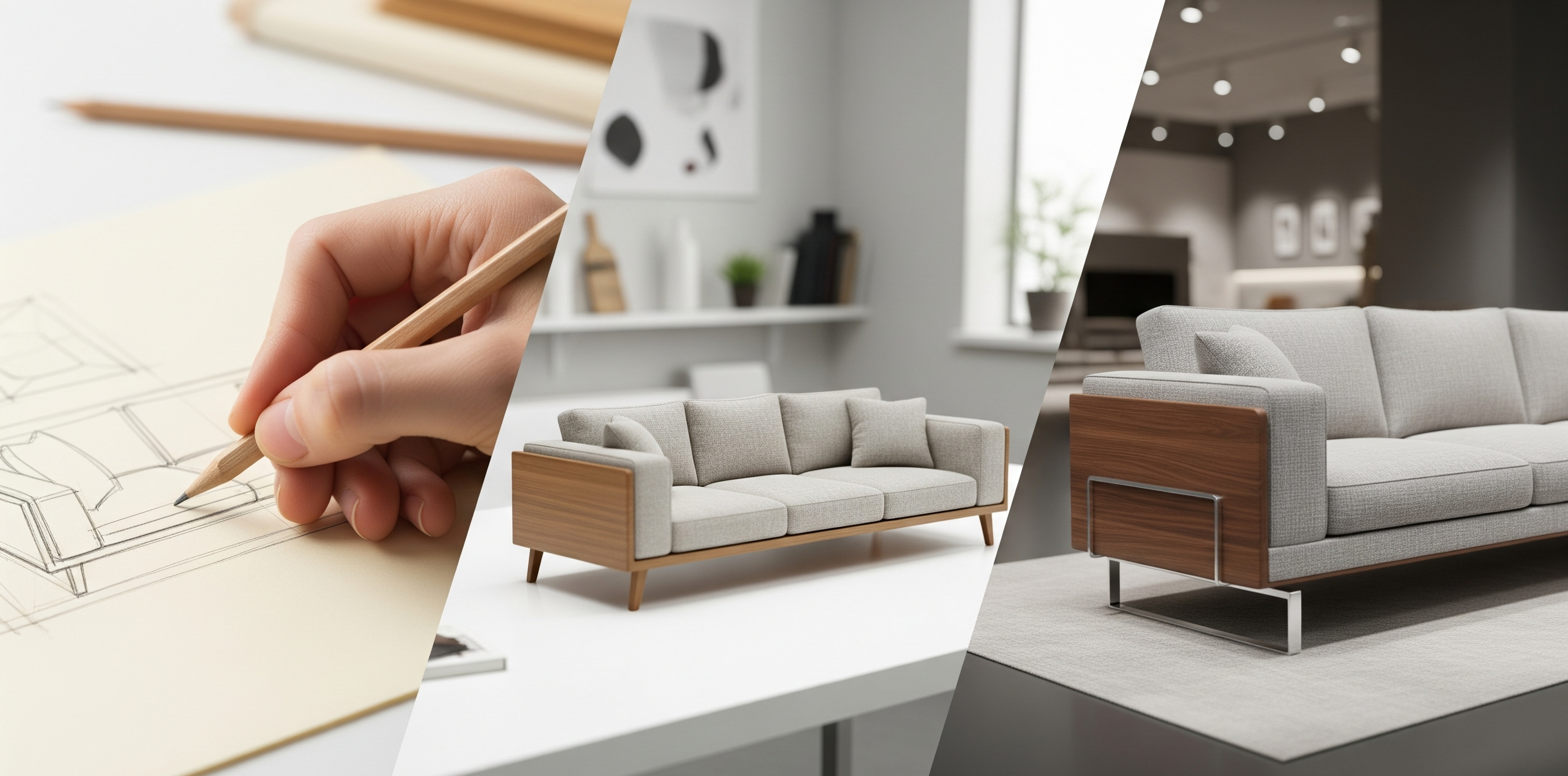
Physical prototyping has always been one of the most expensive parts of furniture development. Every material sample, every joint test, every finish comparison usually means building something by hand before anyone knows if the design actually works. 3D rendering for furniture prototyping replaces most of that process with a digital model that can be tested, adjusted, and approved before a single physical unit exists.
This guide covers how 3D rendering fits into furniture prototyping, what it actually replaces, what it costs, and where it still falls short of a physical prototype.
What Is 3D Prototyping for Furniture?
3D prototyping for furniture means building a digital model of a design, complete with accurate dimensions, materials, and finishes, and using that model to test and refine the design before manufacturing. Instead of a physical mockup, the design exists as a 3D file that can be viewed from any angle, rendered in different materials, and shared for feedback instantly.
It isn’t a full replacement for physical prototyping. Structural testing, load-bearing checks, and how a material actually feels still require a physical unit at some point. What 3D prototyping replaces is the visual and proportional iteration that used to require a new physical version every time something changed.
How It Fits Into the Design Process
Most furniture designs go through several rounds of revision before they’re locked in: proportions get adjusted, materials get swapped, finishes get compared. Traditionally, each of those rounds meant a new physical sample.
With a 3D model, that iteration happens digitally first. A designer can test a chair in oak, walnut, and ash without building three chairs. A manufacturer can check whether a table’s legs look right at three different heights without cutting the wood three times. By the time a physical prototype does get built, most of the visual and proportional decisions are already made, so the physical version exists to confirm the design rather than to figure it out.
Key Benefits of 3D Prototyping
Fewer wasted physical prototypes. Testing proportions, materials, and finishes digitally first means fewer physical versions get built purely to answer a visual question. The physical prototypes that do get made are closer to final, since the guesswork has already been resolved in 3D.
Faster feedback loops. A rendered design can be shared with a client or team and reviewed within hours instead of waiting on a new physical sample. Revisions can be implemented and re-shared in the same week.
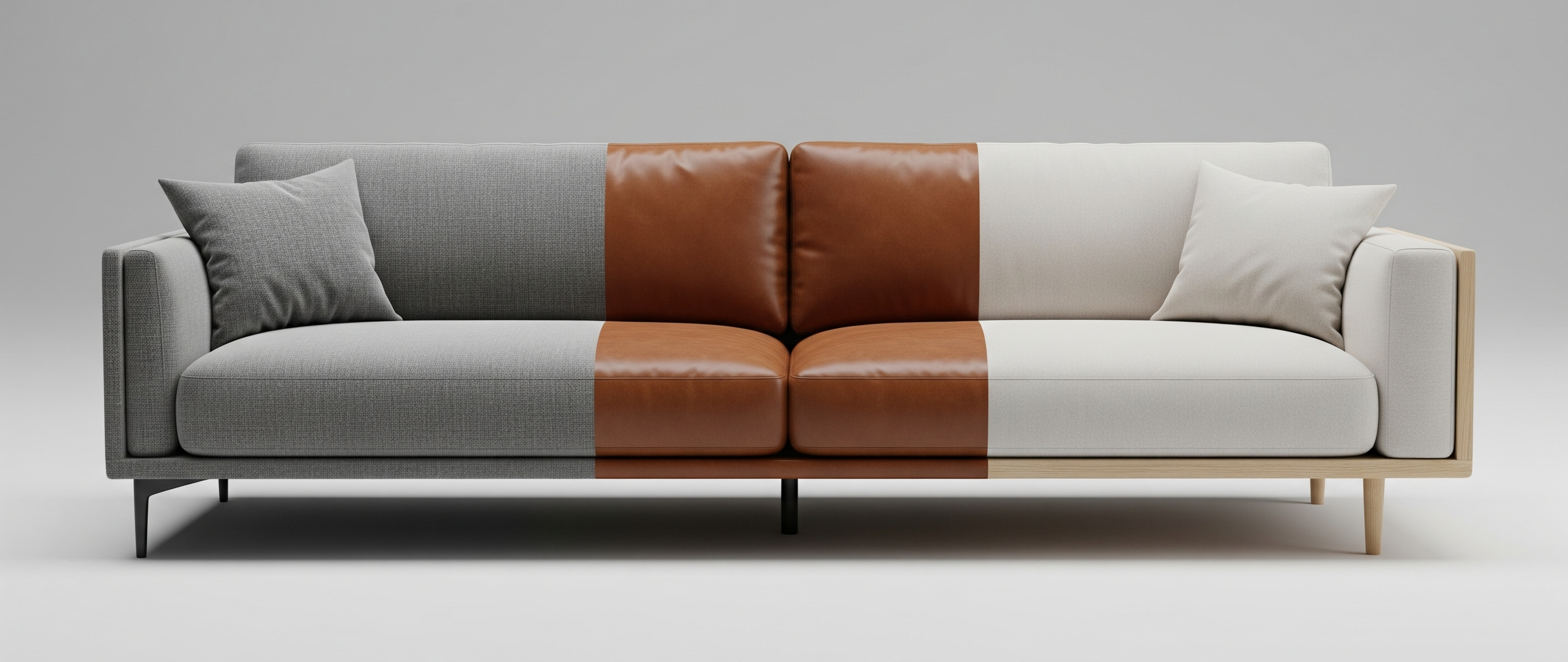
Material and finish testing without rebuilding. Seeing a design in walnut versus black powder-coated metal doesn’t require two physical builds. It’s a material swap on the same 3D model.
Catching design flaws early. Rendering a design in a scaled 3D environment can reveal proportion issues, misaligned parts, or awkward angles before they become expensive mistakes in a physical build.
Clearer client communication. A photorealistic render, down to the shadows and fabric folds, gives clients a much clearer sense of the finished product than a sketch or a flat CAD drawing, which usually means fewer rounds of back-and-forth before approval.
Manufacturing-ready reference. A detailed 3D model carries real dimensions and material data that can support CNC machining references, upholstery planning, and assembly documentation, not just marketing images.
Marketing assets before manufacturing. Once a 3D model exists, it can produce catalog and e-commerce visuals before the physical product is in production, which is particularly useful for launching pre-orders or pitching to retail buyers ahead of a manufacturing run.
What It Costs
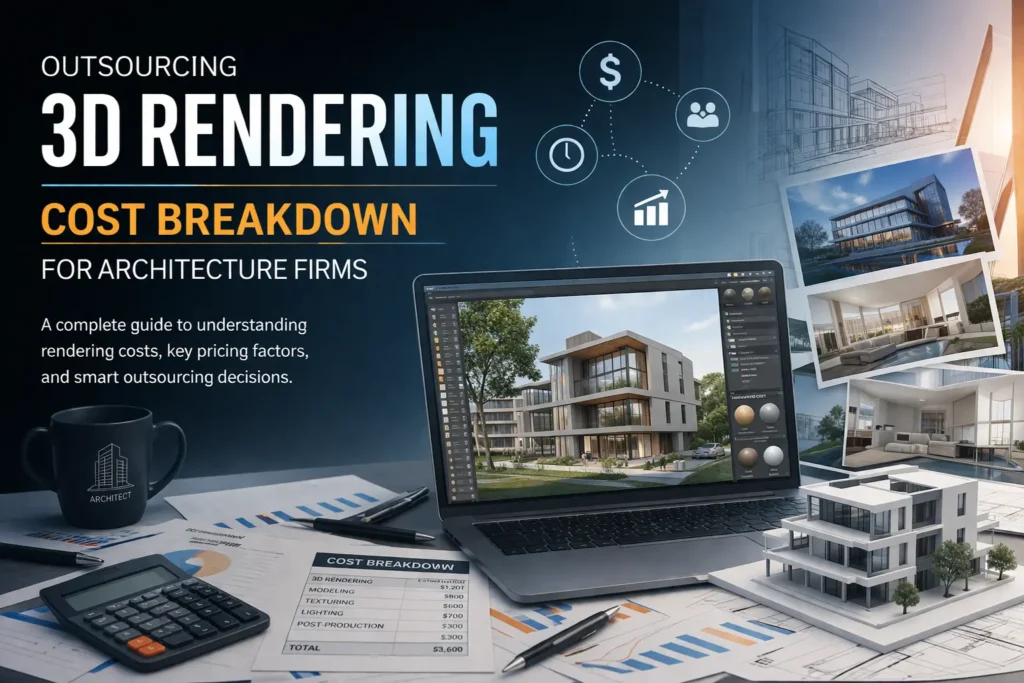
Furniture 3D modeling pricing runs across three tiers, based on how complex the piece is and how many material or finish variations are needed:
- Basic — from $25. Suited to simple pieces with a single finish and straightforward geometry, like a basic chair or side table in one material.
- Standard — from $35. Covers moderately complex pieces or a small number of finish variations, such as a sofa shown in two or three upholstery options.
- Premium — from $45. For complex pieces, multiple components, or several material and finish variations on the same design, like a modular seating system shown across multiple configurations and upholstery choices.
A few things that move a piece up a tier: the number of distinct materials or finishes it needs to be shown in, how many components or moving parts it has (a modular sofa versus a single chair), and whether the model needs to support multiple angles or configurations rather than one fixed view.
Because the underlying 3D model is reusable, adding an extra finish or material variation to an existing model costs less than modeling the piece from scratch a second time. If you know upfront that a design will need to be shown in several finishes, it’s worth briefing all of them at once rather than requesting them one at a time.
Where 3D Prototyping Isn’t Enough
A 3D model can’t tell you how a joint holds up under repeated stress, how a cushion actually compresses, or how a finish wears over time. For anything involving structural integrity, material durability, or ergonomics, a physical prototype at some stage is still necessary. The realistic use case is fewer physical prototypes, built later in the process and closer to final, not zero physical prototypes.
FAQ
Can 3D rendering fully replace physical prototyping?
Not entirely. It replaces most of the visual and proportional iteration, but structural testing, material durability, and how something physically feels still require a real prototype at some point.
How much does 3D furniture prototyping cost?
Furniture modeling starts at $25 for a Basic package, with Standard at $35 and Premium at $45, depending on complexity and the number of finish or material variations needed.
How long does it take to get a 3D prototype render?
Turnaround depends on the complexity of the piece and how many material or finish variations are needed. Simple pieces in a single finish can be turned around faster than a modular design shown in multiple configurations.
Do I need a finished CAD file to start?
No. A 3D model can be built from sketches, reference photos, or rough dimensions if formal CAD files aren’t ready yet.
Can the same 3D model be used for marketing after prototyping?
Yes. Once a model exists for prototyping, it can be reused for catalog images, e-commerce listings, or pre-launch marketing without building a new asset from scratch.
Ready to prototype your next design in 3D?
Test proportions, materials, and finishes before you build a single physical sample.
Start your project →