New York advertising agencies work under a pressure most industries never experience — impossible deadlines, demanding clients, and production budgets that disappear fast. A single product shoot in Manhattan can run $10,000 to $50,000 per day, and when the client requests a color change or a new angle after delivery, that cost resets almost entirely.
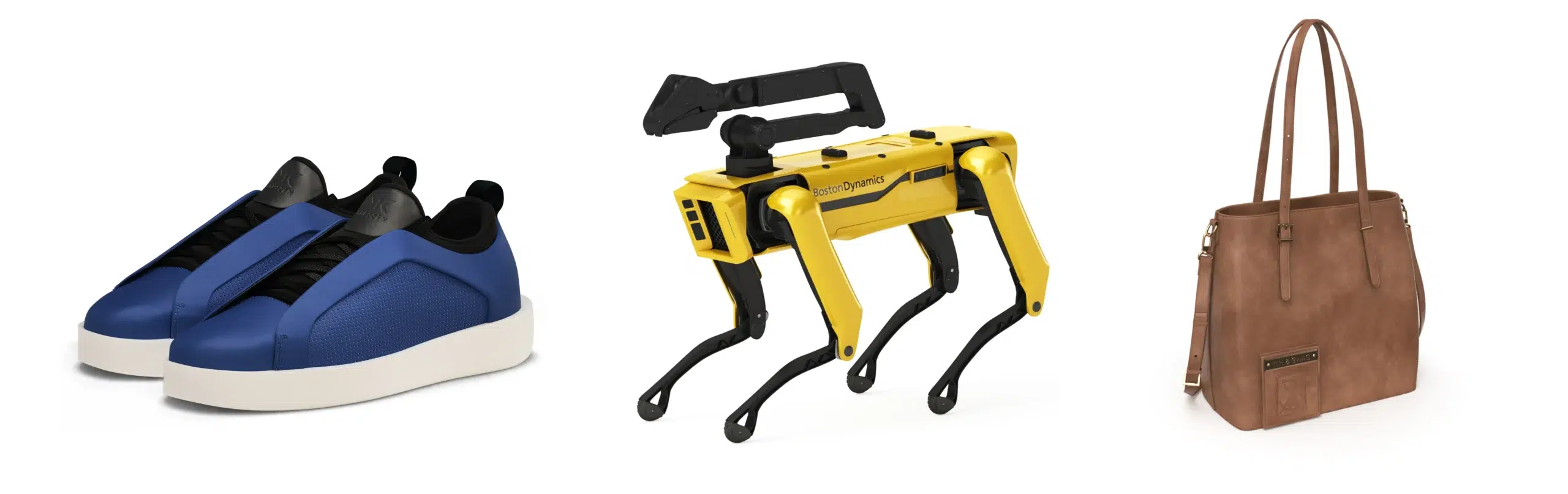
3D product rendering for advertising agencies changes that equation. Agencies get photorealistic product visuals built entirely in software — no studio rental, no physical samples, no reshoot costs. Changes are made in the file, not on a set. And with the right rendering partner, turnaround fits inside an agency campaign timeline, not around it.
4dviz works with advertising agencies that need campaign-ready 3D product visuals delivered fast, at a standard that holds up next to anything produced by a New York studio — at a fraction of the cost. Whether you’re producing for a product launch, a seasonal campaign, or an ongoing catalogue, this is what professional 3D rendering looks like when it’s built around agency workflow.
Whether you’re new to 3D rendering or looking to scale your visual production, this 3D product rendering guide for advertising agencies covers everything you need to make the right call.
Why Advertising Agencies in New York Are Adopting 3D Rendering
Advertising agencies have always been under pressure to produce more — more formats, more variants, more platforms — without more budget. 3D product rendering directly solves that problem.
The traditional production model breaks down at scale. When a campaign needs a hero image, six platform-specific crops, three colorway variants, and a lifestyle version — all from the same product — a photo shoot becomes a logistical and financial nightmare. 3D rendering produces all of those outputs from a single model, without scheduling a second shoot or shipping a physical sample.
For New York agencies specifically, the economics are stark. Local production costs are among the highest in the world. A rendering studio that delivers the same visual quality — on time, with full revision flexibility — at 30 to 60 percent of local production cost is not a compromise. It’s a smarter allocation of the same campaign budget.
Beyond cost, 3D rendering gives creative teams genuine control. Lighting, camera angle, environment, color, material finish — all adjustable at any stage of the process, without being locked into what was set up on shoot day. For agencies that need to move fast and iterate freely, that flexibility is not a nice-to-have. It’s the whole point.
To fully appreciate its value, it is important to understand why 3D product rendering matters for modern businesses — from cost savings to faster time-to-market.
What advertising agencies use 3D product rendering for
Digital advertising and social campaigns
When a campaign runs across Instagram, Meta ads, Google Display, connected TV, and out-of-home simultaneously, every format has different dimensions, crops, and visual requirements. 3D product rendering makes multi-format production straightforward — the same product model is repositioned, relit, and re-rendered for each format without reshooting anything. Creative teams get consistent product representation across every placement, with none of the inconsistency that comes from stitching together assets from multiple shoot days.
E-commerce and retail listings
Product pages are where campaigns convert — and the quality of the product visual is directly tied to conversion rate. 3D renders give agencies the ability to deliver clients clean silo images, lifestyle contexts, zoom-capable detail shots, and 360° spins from a single production run. For clients managing hundreds of SKUs or frequent product updates, 3D is the only production method that scales without the cost ballooning proportionally.
Research from Shopify consistently shows that product image quality is one of the top factors influencing purchase decisions for online shoppers.
Hero and campaign imagery
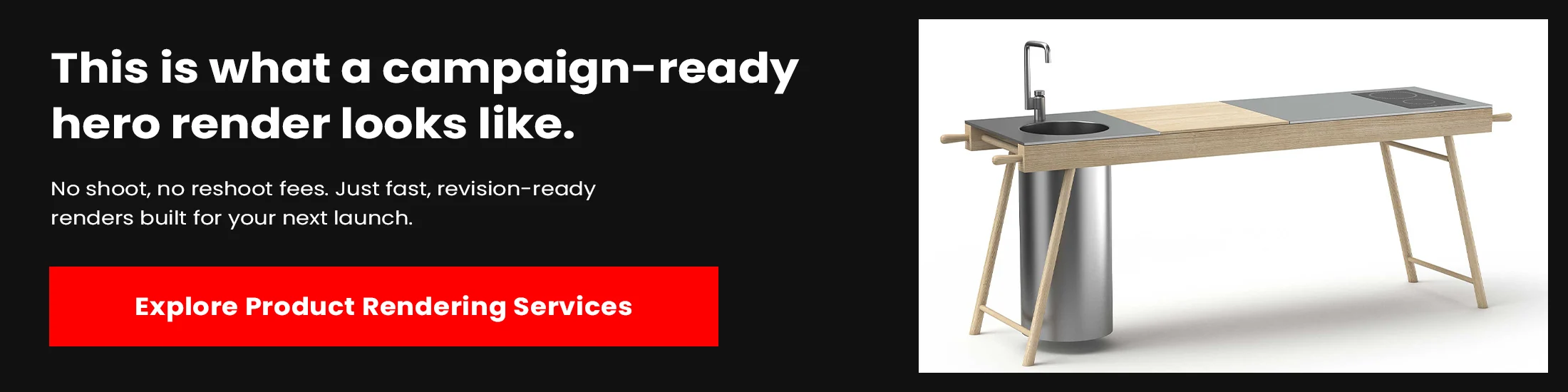
The most demanding use case for any rendering studio is the campaign hero — an image that anchors a product launch, a brand campaign, or a seasonal push. These renders require precise art direction: specific lighting moods, composed environments, exact material rendering. 4dviz produces hero renders built to agency spec, using Cinema 4D, Blender, and V-Ray, with revision rounds built into the delivery process so creative directors can refine without starting over.
Product catalogue and variant photography
Clients in fashion, consumer goods, electronics, and home decor routinely need the same product visualized across dozens of color and material variants. With traditional photography, each variant is a separate setup. With 3D, every variant is generated from the same base model — same lighting, same angle, same quality — in a fraction of the time. Agencies delivering catalogue work for these clients can offer faster turnaround and lower per-image costs without touching their own margin.

Cost advantage — remote studio vs local production
For advertising agencies in New York, the cost argument for 3D product rendering is straightforward — but the real advantage isn’t just cheaper images. It’s what that cost structure makes possible.
A New York studio day rate for product photography runs $3,000 to $10,000 before you factor in photographer fees, prop sourcing, talent, and post-production. For a single product in two colorways shot across three setups, you’re looking at a significant portion of a campaign’s entire production budget — spent before a single ad goes live.
4dviz delivers the same caliber of output at a fundamentally different price point. Simple silo renders start at $50–$150 per image. Lifestyle and campaign renders run $400–$1,200 depending on scene complexity. A full campaign asset set — hero image, variant renders, e-commerce shots, and platform crops — that would require multiple shoot days in New York can be produced in 5–7 business days remotely, with revisions included.
The other cost advantage is longevity. A 3D model built for one campaign is a reusable asset. Next season’s campaign, a new colorway, a different background scene — all produced from the same model at a fraction of the original cost. Agencies that build on a 3D production foundation stop paying full production rates every time a client needs something updated.
And on the quality question — 4dviz works to the same output specifications used by agencies serving global FMCG, tech, and consumer brands. The renders are delivered in the formats, resolutions, and color profiles that professional advertising production requires. Location doesn’t change what the file looks like when it opens on a creative director’s screen in Manhattan.
According to Forbes, augmented reality is rapidly becoming a standard part of next-generation marketing — and 3D product models are the foundation every AR experience is built on.
How 4dviz works with advertising agencies
Working with a remote rendering studio is only as smooth as the process behind it. Here’s how 4dviz handles projects for advertising agencies, from first brief to final delivery.
Brief and intake
Send us your product reference files — CAD files, technical drawings, physical samples, or reference photography — along with your campaign brief, preferred angles, and any visual references. The more context upfront, the faster and more accurate the first round of renders.
Modeling and texturing
Our team builds or refines the 3D model, applies accurate material textures, and sets up lighting to match your brief. For complex products or tight deadlines, we’ll share a low-resolution preview before committing to the final render.
Review and revision
First renders are delivered for creative review. Standard projects include two revision rounds — adjustments to lighting, angle, color, background, or composition. Additional rounds are available on request. Most revision cycles are completed within 24 hours.
Final delivery
Finished renders are delivered in your required formats — high-resolution TIFF or PNG for print, optimized JPG or WebP for digital, with layered PSD files available on request. Source 3D files can be included in the package for agencies that want to retain the asset for future use.
Turnaround
Standard delivery: 3–5 business days for most render sets. Rush delivery in 24–48 hours is available for campaign-critical deadlines. We work in UTC+6 — briefs sent end-of-day New York time are typically in production overnight and ready for morning review.
Frequently Asked Questions (FAQs)
1. Can a studio based in Bangladesh deliver to New York agency standards?
Yes — and the output speaks for itself. 4dviz produces renders to the same specifications required by agencies working with global consumer, tech, and fashion brands. Resolution, color accuracy, file format, and delivery structure all match professional advertising production standards. Many of the world’s leading agencies already work with remote creative partners across time zones. What matters is the quality of the file, the reliability of the process, and the responsiveness of the team — all of which we’re happy to demonstrate with a sample render before you commit to a full project.
2. How fast can you turn around campaign renders?
Standard turnaround is 3–5 business days for a typical render set. Rush delivery in 24–48 hours is available for campaign deadlines — let us know upfront and we’ll build the timeline around your launch date. Our UTC+6 timezone means briefs sent at end-of-day New York time are often in production overnight, with first renders ready for your morning review.
3. What files do we need to provide?
Ideally a CAD or 3D model file (STEP, OBJ, FBX). If you don’t have one, we can build from scratch using product dimensions, technical drawings, reference photography, or a physical sample. The more reference material you send, the more accurate the first round will be.
4. How many revision rounds are included?
Two rounds are included as standard. Each revision cycle — adjustments to lighting, angle, color, material, or background — is typically completed within 24 hours. Additional rounds are available if the project scope requires it.
5. Can we retain the 3D model for future campaigns?
Yes. Source 3D files can be included in your delivery package, giving your agency or your client a reusable asset for future campaigns, variant shoots, AR experiences, or product configurators. This is one of the strongest long-term advantages of building on a 3D production pipeline — you pay for the model once and leverage it across multiple campaigns.
Conclusion
Advertising agencies that invest in 3D product rendering for advertising agencies don’t just cut production costs — they gain a production model that actually fits how campaigns work. Faster iteration, unlimited variants, consistent quality across every format, and assets that stay useful long after the campaign ends.
4dviz was built to work alongside agencies that operate at this level. We understand campaign timelines, creative director feedback cycles, and the kind of output that holds up in a New York client presentation. If you’re evaluating 3D product rendering for your agency’s production workflow, we’d like to show you what we can do.