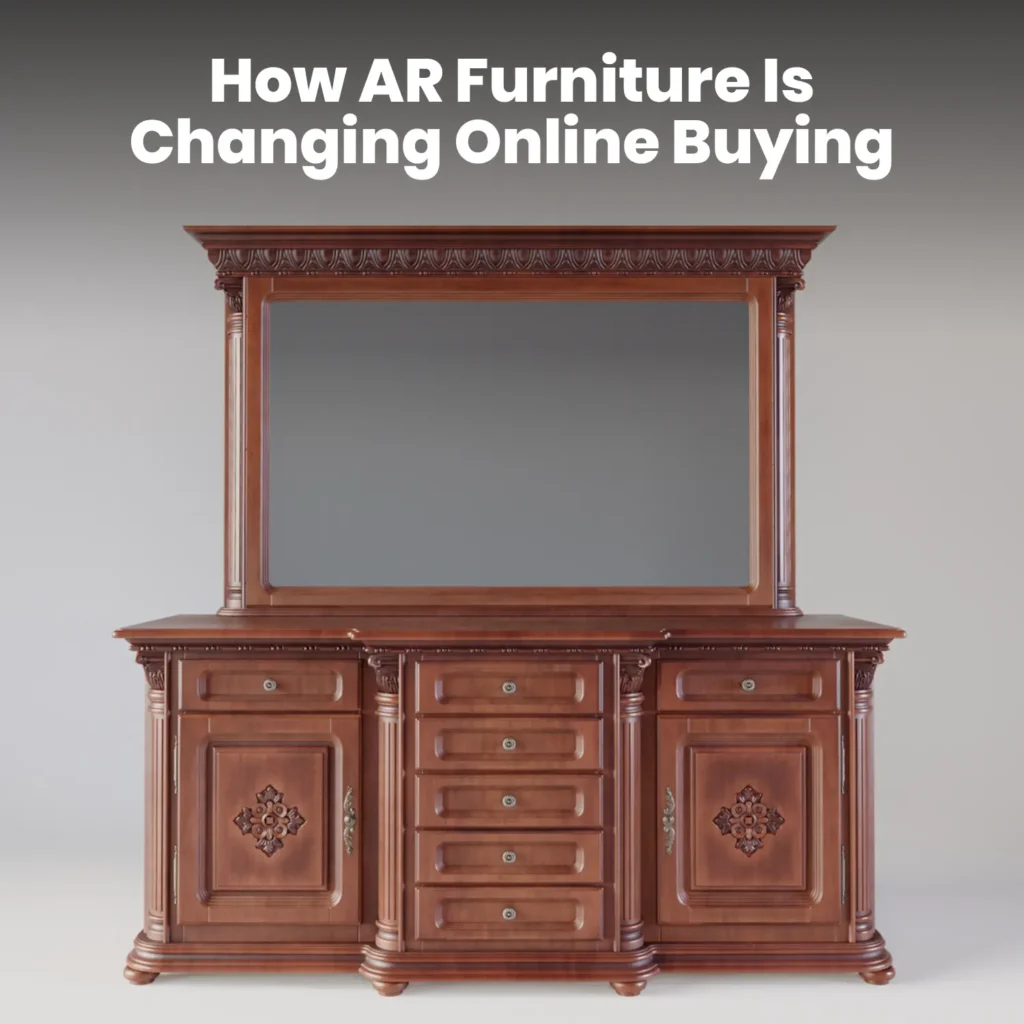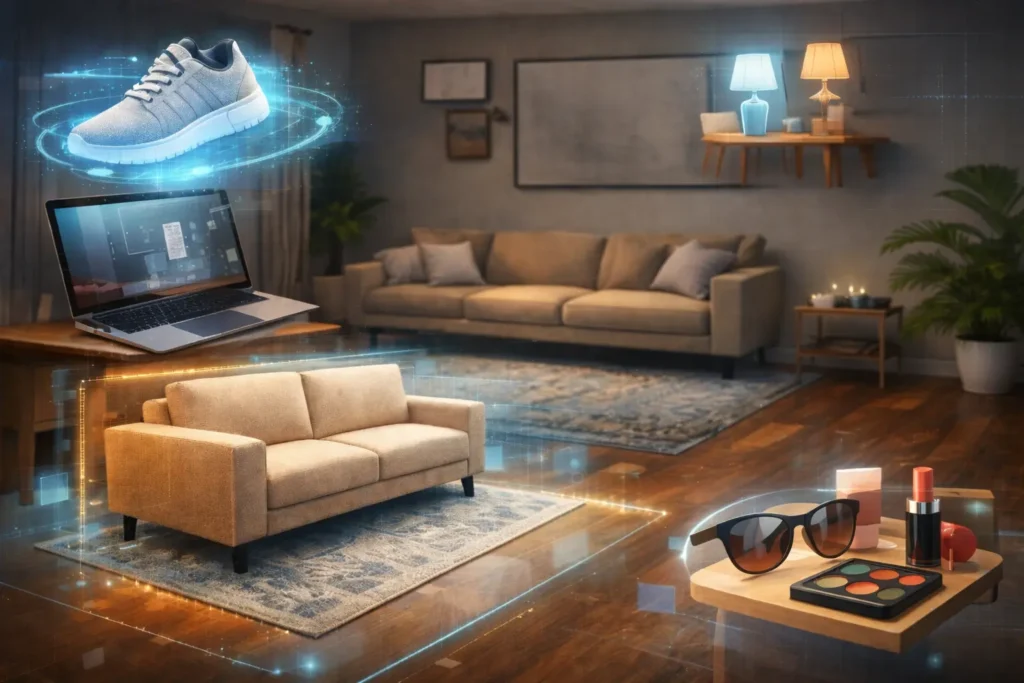
The way people shop for furniture online is undergoing a major transformation. For years, customers relied on static images, product descriptions, and imagination to decide whether a sofa, table, or bed would fit their space. That uncertainty often led to hesitation, abandoned carts, or costly product returns. Today, AR furniture and augmented reality furniture visualization are redefining the digital shopping experience.
By enabling customers to place true-to-scale 3D models of products directly into their homes using a smartphone, AR furniture technology bridges the gap between online browsing and real-world experience. As ecommerce competition intensifies, AR in furniture ecommerce is no longer a novelty — it is becoming a strategic advantage.
This article explores how AR furniture is changing online buying behavior, increasing conversion rates, reducing return rates, and reshaping the future of digital retail.
The Problem With Traditional Online Furniture Shopping
Furniture is a high-consideration purchase. Unlike clothing or small accessories, buyers must consider:
- Room dimensions
- Product scale and proportions
- Color matching with interiors
- Lighting conditions
- Style compatibility
Without the ability to physically test a product, customers face purchase uncertainty, leading to common issues such as:
- Furniture size confusion online
- Color mismatch after delivery
- Poor spatial planning
- High return rate in furniture ecommerce
Traditional ecommerce product photography, even with multiple angles, cannot fully communicate spatial context. This is where 3D furniture visualization and AR-powered solutions provide measurable value.
What Is AR Furniture Shopping?
AR furniture shopping uses augmented reality technology to overlay digital 3D models into a user’s real-world environment through a smartphone or tablet camera.
Instead of guessing, customers can:
- Place a sofa in their living room
- Test multiple color variations
- View products at true-to-scale dimensions
- Walk around the product virtually
- Adjust position and orientation
Major retailers such as IKEA, Wayfair, and Amazon have implemented AR features that allow users to preview furniture in real environments before purchasing.
This interactive product visualization reduces cognitive friction and builds buyer confidence.
How AR Furniture Works
AR furniture solutions rely on several integrated technologies:
- Photorealistic 3D models
- Real-time 3D rendering
- SLAM (Simultaneous Localization and Mapping) tracking
- Mobile AR frameworks such as ARKit and ARCore
- WebAR or app-based AR integration
The process typically involves:
- Creating optimized 3D furniture models (GLB or USDZ formats).
- Integrating the models into an ecommerce platform.
- Enabling “View in Room” functionality through WebAR or app-based AR.
- Using the device camera to detect surfaces and place objects accurately.
Modern spatial visualization technology ensures accurate scaling and surface detection, improving realism and usability.
Why AR Furniture Is Changing Online Buying Behavior
1. It Increases Purchase Confidence
One of the biggest barriers in online furniture shopping is doubt. Customers frequently ask:
- Is AR furniture accurate?
- Can I see furniture in my room before buying?
- How to visualize a sofa in my room online?
AR removes guesswork by showing exact dimensions and realistic placement. When customers can see how a product fits within their personal space, they gain confidence in their decision.
This results in:
- Higher customer engagement
- Improved trust in online furniture stores
- Faster decision-making
2. It Reduces Furniture Return Rates
Furniture returns are expensive due to shipping, handling, and restocking costs. Many returns happen because:
- The item was too large or too small
- The color did not match expectations
- The style felt different in person
By allowing virtual furniture placement before purchase, AR significantly reduces wrong-size and mismatch purchases. Studies across ecommerce sectors show that interactive product visualization reduces return rates and improves customer satisfaction.
For retailers, this directly impacts profit margins.
3. It Boosts Conversion Rates and Sales
AR improves the online shopping experience by making it immersive and interactive. Instead of passive browsing, customers actively engage with products.
Benefits include:
- Increased time on site
- Higher add-to-cart rates
- Better conversion optimization
- Reduced hesitation
Retailers frequently ask:
“Does AR increase furniture sales?”
“Is augmented reality worth it for ecommerce?”
The answer increasingly appears to be yes. By creating immersive shopping experiences, brands differentiate themselves in crowded markets.
4. It Creates a Competitive Advantage
Early adopters of AR furniture solutions position themselves as innovative and customer-focused. Companies like Houzz and Shopify support AR integration for merchants, making it easier for furniture brands to adopt the technology.
In competitive ecommerce environments, offering AR furniture visualization can:
- Increase brand authority
- Improve user retention
- Strengthen digital transformation strategy
- Enhance customer experience
AR vs Traditional Product Images
While high-quality product photography remains important, AR goes beyond static visuals.
| Feature | Traditional Images | AR Furniture |
| Spatial context | Limited | Real-world placement |
| True-to-scale view | No | Yes |
| Interactivity | Minimal | High |
| Personalization | Low | High |
| Engagement level | Moderate | Strong |
This does not mean replacing product photography entirely. Instead, leading brands combine:
- White background renders
- Lifestyle scenes
- Interactive 3D product viewers
- Augmented reality previews
The integration of photorealistic 3D models with AR creates a complete digital shopping ecosystem.
WebAR vs App-Based AR
There are two primary implementation methods:
WebAR Furniture Solution
- Runs directly in a mobile browser
- No app download required
- Faster adoption
- Ideal for ecommerce websites
App-Based AR
- Integrated into branded apps
- Higher performance capabilities
- More advanced interaction features
For many ecommerce businesses, WebAR furniture integration offers lower friction and broader accessibility.
Business Benefits of AR in Furniture Ecommerce
For retailers and manufacturers, AR furniture solutions deliver measurable advantages:
1. Reduced Operational Costs
Lower return rates mean reduced logistics expenses and better inventory management.
2. Faster Customer Decision-Making
Interactive previews shorten the buying cycle.
3. Improved Customer Engagement
Customers spend more time interacting with 3D models compared to static images.
4. Higher Average Order Value
When buyers confidently visualize products, they are more likely to purchase complementary items.
5. Data-Driven Insights
AR interactions provide analytics on product engagement, popular styles, and customer preferences.
The Role of 3D Models in AR Furniture
High-quality 3D assets are the foundation of effective AR.
Key requirements include:
- Accurate dimensions
- Realistic textures and materials
- Optimized polygon count
- Fast loading performance
- Mobile compatibility
Photorealistic 3D models for AR must balance realism and performance efficiency. Overly heavy models slow down loading, while low-detail models reduce immersion.
As 3D content becomes more central to ecommerce, furniture brands increasingly invest in digital asset pipelines.
The Future of AR in the Furniture Industry
The next phase of AR furniture shopping will integrate:
- AI-powered recommendations
- Personalized interior design suggestions
- Real-time lighting simulation
- Mixed reality shopping environments
- Virtual showroom experiences
AI + AR furniture shopping systems may soon analyze room dimensions automatically and recommend ideal furniture layouts.
As immersive retail technology evolves, the boundary between online and offline retail will continue to blur.
Challenges and Considerations
Despite its advantages, AR adoption requires:
- Investment in 3D model creation
- Technical integration expertise
- Platform compatibility testing
- Ongoing maintenance
Businesses must evaluate:
- Cost of AR furniture app development
- WebAR vs native app strategy
- Hosting and performance optimization
However, as technology matures, implementation barriers continue to decrease.
Why AR Furniture Is Not Just a Trend
AR furniture is not simply a marketing gimmick. It addresses core ecommerce pain points:
- Trust
- Visualization
- Decision confidence
- Return reduction
- Engagement
By solving real customer problems, augmented reality in furniture ecommerce strengthens the entire digital buying process.
Consumers increasingly expect interactive experiences. Brands that fail to adapt risk falling behind competitors that offer immersive, data-driven solutions.
Conclusion
AR furniture is fundamentally reshaping online buying. By combining 3D furniture visualization, spatial computing, and real-time rendering, augmented reality transforms uncertainty into clarity.
Customers gain:
- Accurate product visualization
- Higher purchase confidence
- Reduced risk
Businesses gain:
- Improved conversion rates
- Lower return costs
- Stronger competitive positioning
As ecommerce continues to evolve, augmented reality furniture visualization will move from optional innovation to standard expectation. For furniture retailers, manufacturers, and digital commerce platforms, investing in AR is no longer about experimentation — it is about future-proofing the online buying experience.
The digital showroom has arrived, and it is powered by AR.