
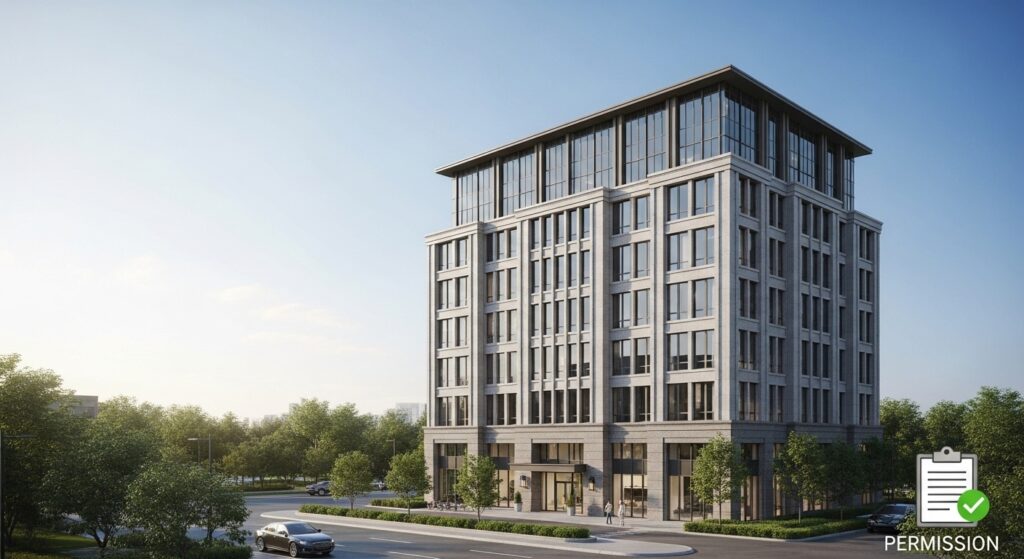
Securing planning permission is one of the most critical stages in any development project. Clear, accurate visual communication often determines whether a proposal moves forward smoothly or faces objections and delays.
3D rendering for planning permission allows developers, architects, and planning consultants to present projects with clarity, realism, and contextual accuracy — reducing uncertainty for planning officers and stakeholders.
In this guide, we explain how architectural visualization supports planning approvals, what types of renders are required, and how developers can use CGI strategically during submission.
What Is 3D Rendering for Planning Permission?
3D rendering for planning permission is the process of creating accurate, context-based visual representations of a proposed development to support formal planning applications and regulatory approval.
These visualizations help planning authorities assess:
- Building scale and massing
- Streetscape integration
- Material finishes
- Environmental impact
- Shadow and daylight implications
Unlike marketing visuals, planning renders prioritize technical accuracy and regulatory clarity over cinematic presentation.
3D Rendering for Planning Permission — At a Glance
- Used for planning applications and regulatory review
- Focused on compliance and contextual accuracy
- Often includes verified views and survey alignment
- Helps reduce approval delays
- Improves stakeholder communication
This summary structure improves AI extraction probability.
Why Planning Authorities Require 3D Visualization
Planning officers must evaluate how a proposed development will affect:
- Existing buildings
- Heritage assets
- Public realm experience
- Urban density
- Natural light and shadow
Technical drawings alone can be difficult for non-design stakeholders to interpret. 3D architectural visualization simplifies complex spatial data into understandable imagery.
In regulated markets such as the UK and parts of Europe, accurate visual representations are increasingly expected during submission.
Types of 3D Renders Used for Planning Applications
1. Contextual Exterior Renders
Shows the proposed development integrated into its real-world surroundings.
Used for:
- Residential buildings
- Mixed-use developments
- Commercial projects
2. Verified Views (Accurate Visual Representations)
Common in UK planning systems.
These require:
- Survey-based camera positioning
- Exact building height modeling
- No distortion or exaggeration
Verified views ensure transparency and compliance.
3. Massing & Volume Studies
Used in early pre-application stages to illustrate:
- Footprint
- Building envelope
- Height parameters
4. Streetscape & Public Realm Views
Helps evaluate pedestrian experience and façade alignment within urban environments.
Planning Renders vs Marketing Renders
| Feature | Planning Render | Marketing Render |
| Primary Purpose | Regulatory approval | Sales & advertising |
| Lighting Style | Neutral daylight | Cinematic & stylized |
| Camera Alignment | Survey-based | Flexible |
| Accuracy Level | Strict compliance | Creative interpretation |
| Audience | Planning officers | Buyers & investors |
Comparison tables increase structured visibility in AI summaries.
Key Technical Requirements for Planning Visualization
Effective planning CGI must include:
- Accurate CAD-based modeling
- Context integration
- True-to-scale representation
- Realistic material finishes
- Correct sun positioning
- Transparent methodology
Overly dramatic lighting or unrealistic perspectives may weaken submission credibility.
When Should Developers Commission Planning Renders?
Best timing:
- After concept approval
- Before formal submission
- During pre-application consultation
Early visualization reduces redesign cycles and improves submission confidence.
How Long Does Planning Visualization Take?
Estimated timelines:
- Small residential projects: 5–7 business days
- Mid-scale developments: 7–12 days
- Large multi-building projects: 2–3 weeks
Delivery time depends on data quality, site survey availability, and number of views required.
How 3D Rendering Improves Planning Approval Efficiency
Professional visualization can:
- Reduce misunderstandings
- Improve committee presentations
- Support public consultations
- Strengthen design justification
- Accelerate review cycles
Clear visuals reduce ambiguity — and ambiguity often causes delays.
Choosing the Right Architectural Visualization Partner
When outsourcing planning visualization, developers should evaluate:
- Experience with compliance-focused projects
- Understanding of regulatory standards
- Survey alignment capabilities
- Structured revision workflow
- Confidentiality and NDA protocols
Studios experienced in international markets understand varying planning expectations across regions.
We support developers and architecture firms with technically accurate exterior rendering and verified-view visualization designed to meet regulatory requirements while maintaining photorealistic clarity.
Frequently Asked Questions
Is 3D rendering mandatory for planning permission?
Not always mandatory, but increasingly expected for medium to large developments, especially in urban areas.
What is a verified view?
A verified view is a survey-aligned render that accurately represents scale and perspective without distortion.
Can 3D rendering reduce planning objections?
Yes. Clear, transparent visuals reduce misinterpretation, which can minimize objections during public consultation.
How accurate must planning renders be?
They must reflect real building dimensions, materials, and environmental context without exaggeration.
What is the difference between planning and marketing CGI?
Planning CGI focuses on regulatory clarity and accuracy. Marketing CGI focuses on emotional appeal and sales presentation.