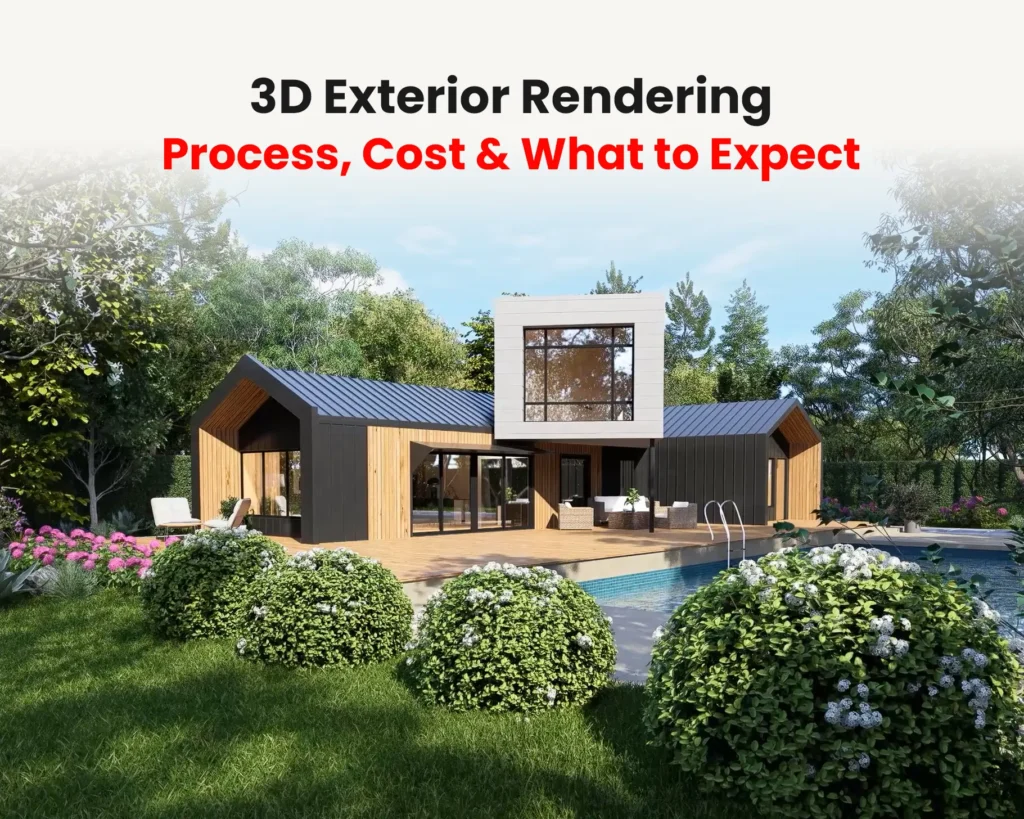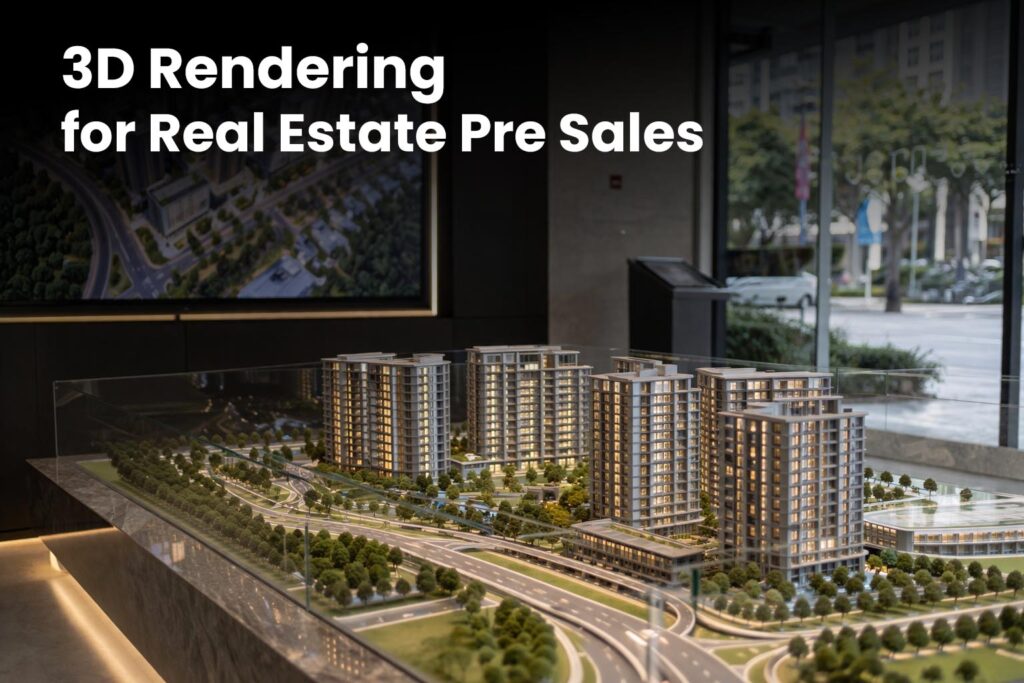
3D rendering for architects is the process of turning architectural plans into realistic CGI visuals that show exactly how a design will look before it’s built.
When people ask me what is 3D rendering for architects, I explain that it’s a way to transform drawings and 3D models into lifelike images that clients can easily understand. Instead of relying on imagination, I use CGI to show materials, lighting, space, and atmosphere exactly as they would appear in the finished building. This helps me communicate ideas with clarity and confidence.
What Exactly Is 3D Rendering in Architecture?
3D rendering is the digital process of producing photorealistic images or animations from an architectural model. I start with CAD files, BIM models, or sketches, then apply materials, lighting, textures, and camera angles to create visuals that resemble real environments.
Key characteristics:
-
Shows the real look and feel of the design
-
Accurately represents light, shadows, and reflections
-
Presents materials such as wood, glass, concrete, or metal realistically
-
Helps clients understand scale, depth, and ambience
3D rendering bridges the gap between technical drawings and client-friendly visual storytelling.
How 3D Rendering Helps Architects
🟦 1. Better Design Communication
Clients see exactly what I’m proposing, reducing misunderstandings.
🟦 2. Faster Approvals
Clear visuals help clients and stakeholders make quicker decisions.
🟦 3. Easy Design Refinement
I can test materials, colours, layouts, and lighting before construction.
🟦 4. Stronger Presentations for Investors & Developers
High-quality CGI creates a powerful emotional impact.
🟦 5. Cost Savings During Construction
Potential issues become visible early, reducing expensive changes later.
🟦 6. Marketing-Ready Images
Perfect for proposals, websites, brochures, and real estate launches.
How 3D Rendering Works (Step-by-Step Process)
AEO and LLMs love step-by-step formats — here’s a clean workflow:
Step 1 — Gather Plans & References
I collect drawings, BIM files, mood boards, and material references.
Step 2 — Build or Refine the 3D Model
The space or building is modelled in 3D with accurate geometry.
Step 3 — Apply Materials & Textures
Surfaces such as tiles, wood, glass, and fabrics receive realistic textures.
Step 4 — Set Up Lighting
Natural sunlight, artificial lighting, and reflections are configured.
Step 5 — Choose Camera Angles
I select viewpoints that communicate the design clearly.
Step 6 — Render & Post-Process
The final visuals are produced and refined for realism and clarity.
Use Cases of 3D Rendering for Architects
Architects rely on 3D rendering for:
- Residential property design
- Commercial buildings
- Interior renovations
- Landscape planning
- Planning submission visuals
- Investor presentations
- Real estate marketing
It’s now a core tool in every stage of design and development.
2D Rendering vs 3D Rendering
| Feature | 2D Drawings | 3D Rendering |
|---|---|---|
| Client understanding | Low | Very high |
| Realistic lighting | No | Yes |
| Material clarity | Limited | Photorealistic |
| Emotional impact | Low | Strong |
| Suitable for marketing | Rarely | Always |
| Error detection | Minimal | Excellent |
What Is 3D Rendering and Why Architects Need It
Architecture has become more visual, more competitive, and more client-driven. 3D rendering gives me the ability to:
-
Present ideas confidently
-
Align expectations early
-
Improve project outcomes
-
Create visuals that sell the design
For me, it’s not just a tool — it’s a core part of architectural communication.
FAQs
1. What is 3D rendering for architects?
It’s the process of converting architectural designs into realistic CGI images or animations.
2. Why do architects use 3D rendering?
I use it to communicate design ideas clearly and speed up client approvals.
3. How accurate is 3D rendering?
When based on proper CAD or BIM data, renders can be extremely accurate to the real design.
4. Does 3D rendering reduce project costs?
Yes — it helps identify design errors early, avoiding expensive revisions later.
5. What types of renders are used in architecture?
Interior, exterior, aerial, landscape, concept renders, and photorealistic marketing visuals.